.png)
.webp)
.webp)
PPC Performance Marketing: The Blueprint for High-ROI Search and Display Ads
.png)

.png)

PPC performance marketing is a data-driven advertising strategy focused on measurable outcomes like CPA and ROAS. Unlike traditional brand awareness, it aligns keyword intent, automated bidding (AI), and conversion tracking to optimize ROI. In 2026, it requires managing signal loss through robust first-party data and cross-channel attribution.
INTRODUCTION
PPC performance marketing is often seen as a straightforward model—run ads, track clicks, and optimize for conversions. In practice, it is more complex.
It operates as a system that connects traffic acquisition, tracking, and conversion performance. When one part is misaligned, results become inconsistent or misleading.
Recent changes have made this harder to manage. Privacy updates particularly Apple’s App Tracking Transparency (ATT) and evolving frameworks like Google’s Privacy Sandbox have reduced trackable user data, with some advertisers seeing 30–50% signal loss, while automated bidding systems can improve conversions by around 10–20% when enough data is available.
At the same time, user behavior has shifted. Many conversions now happen after multiple interactions across search and display channels, not from a single click.
This is why PPC performance marketing is no longer just about campaign setup—it is about managing a system that operates with partial visibility.
WHAT THIS GUIDE COVERS
This guide explains how PPC performance marketing works in practice, including both execution and limitations.
- What PPC performance marketing actually means
- How search and display campaigns work together
- Key metrics and realistic performance ranges
- How PPC campaigns are structured and optimized
- The role of AI, automation, and tracking gaps
- Common issues that affect PPC performance
What Is PPC Performance Marketing?
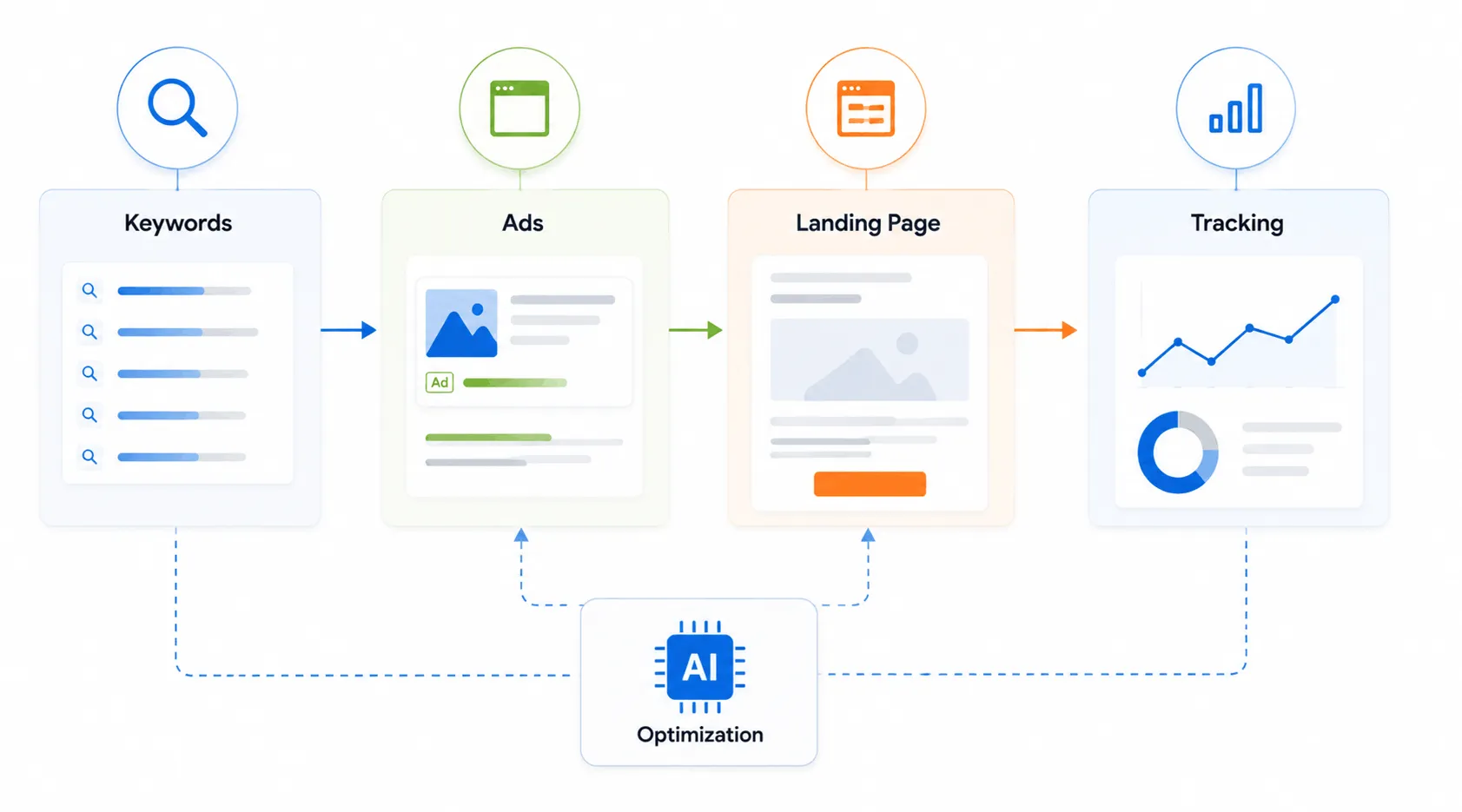
PPC performance marketing is a paid advertising approach where advertisers pay for clicks or conversions and optimize campaigns based on measurable outcomes like cost per acquisition (CPA) or return on ad spend (ROAS).
At a basic level, it includes search ads, display ads, and retargeting. But performance does not come from ad formats alone—it comes from how multiple components work together.
Every PPC system relies on a few core elements:
- keywords that determine when ads appear
- ad copy that drives clicks
- landing pages that convert traffic
- bidding and budgets that control visibility
- tracking that measures outcomes
If one of these underperforms, overall results are affected—even if the others are strong.
In practice, most PPC performance sits within ranges rather than fixed outcomes:
- Search campaigns often generate 2x–5x+ ROAS due to high intent
- Display and prospecting campaigns typically range around 1x–2.5x ROAS
- Search conversion rates often fall between 3%–8%, depending on the query
These ranges reflect how intent varies across channels rather than how “good” a campaign is.
How Do PPC Search and Display Campaigns Work Together?
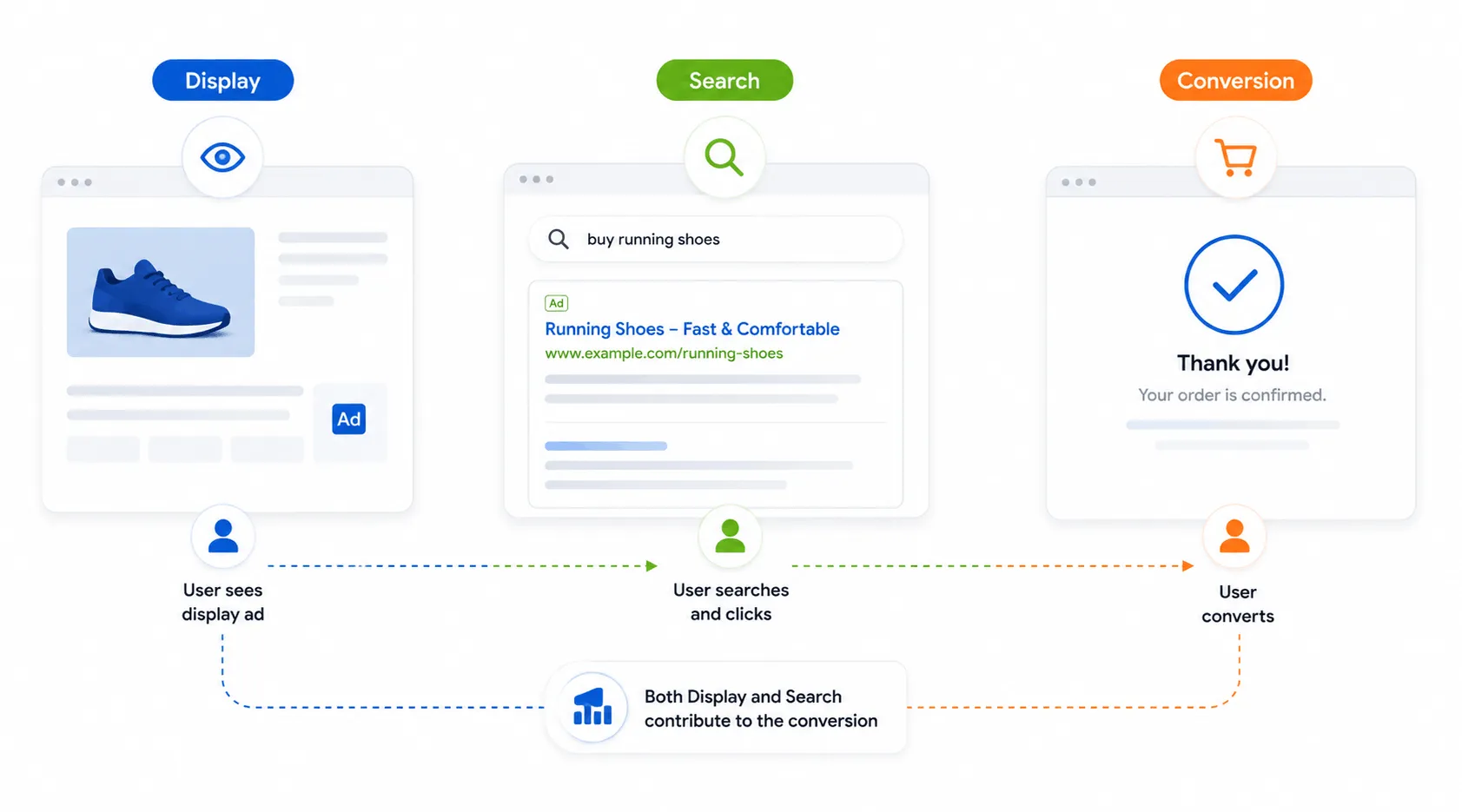
Search and display campaigns work together by covering different stages of the customer journey. Search captures demand, while display helps create and reinforce it.
Search campaigns are driven by keywords. When users actively search for a product or solution, ads appear based on how relevant those keywords are. This is why search tends to convert at higher rates.
Display campaigns operate differently. They reach users based on behavior or context, often before intent is fully formed. Because of this, they rarely drive immediate conversions at the same rate as search.
A typical journey reflects this interaction:
- a user sees a display ad
- later searches for the product
- clicks a search ad and converts
Without a broader view, search appears to drive the result while display appears inefficient. In reality, both contributed to the outcome.
This is also where keyword strategy plays a critical role. Broad keywords can generate volume but often reduce efficiency, while more specific queries tend to convert better but at lower scale. Over time, refining keyword selection—while removing irrelevant queries—has a direct impact on both cost and performance.
What Metrics Actually Matter in PPC Performance Marketing?
PPC performance marketing relies on metrics like ROAS, CPA, and conversion rate, but these metrics only make sense when viewed in context.
What Good Performance Looks Like
Good performance is defined by consistency, not just high numbers.
In most PPC systems:
- ROAS stays above breakeven and remains stable over time
- CPA aligns with margins and does not increase sharply when scaling
- conversion rate holds steady across similar traffic sources
A campaign with moderate performance that scales is usually more valuable than one with strong numbers that cannot grow.
It is also common for platform-reported results to differ from analytics tools, sometimes by 20–40% or more, due to attribution differences and modeled conversions. Many platforms now use Data-Driven Attribution (DDA) or Marketing Mix Modeling (MMM) to address these tracking gaps and provide a more complete view of performance.
How Do You Build a High-ROI PPC Performance Marketing System?
A high-performing PPC system is built by aligning targeting, campaign structure, tracking, and conversion performance—then improving each layer over time.
The process typically starts by identifying what is limiting results. In many cases, the issue is not traffic, but how efficiently that traffic converts.
Common constraints include:
- high cost per click relative to conversion rate
- low landing page performance
- inefficient keyword targeting
Campaign structure also plays a direct role in performance. Clear segmentation—by keyword intent, product category, or audience—makes it easier to control budgets and identify what is working. Poor structure, on the other hand, mixes data and makes optimization harder.
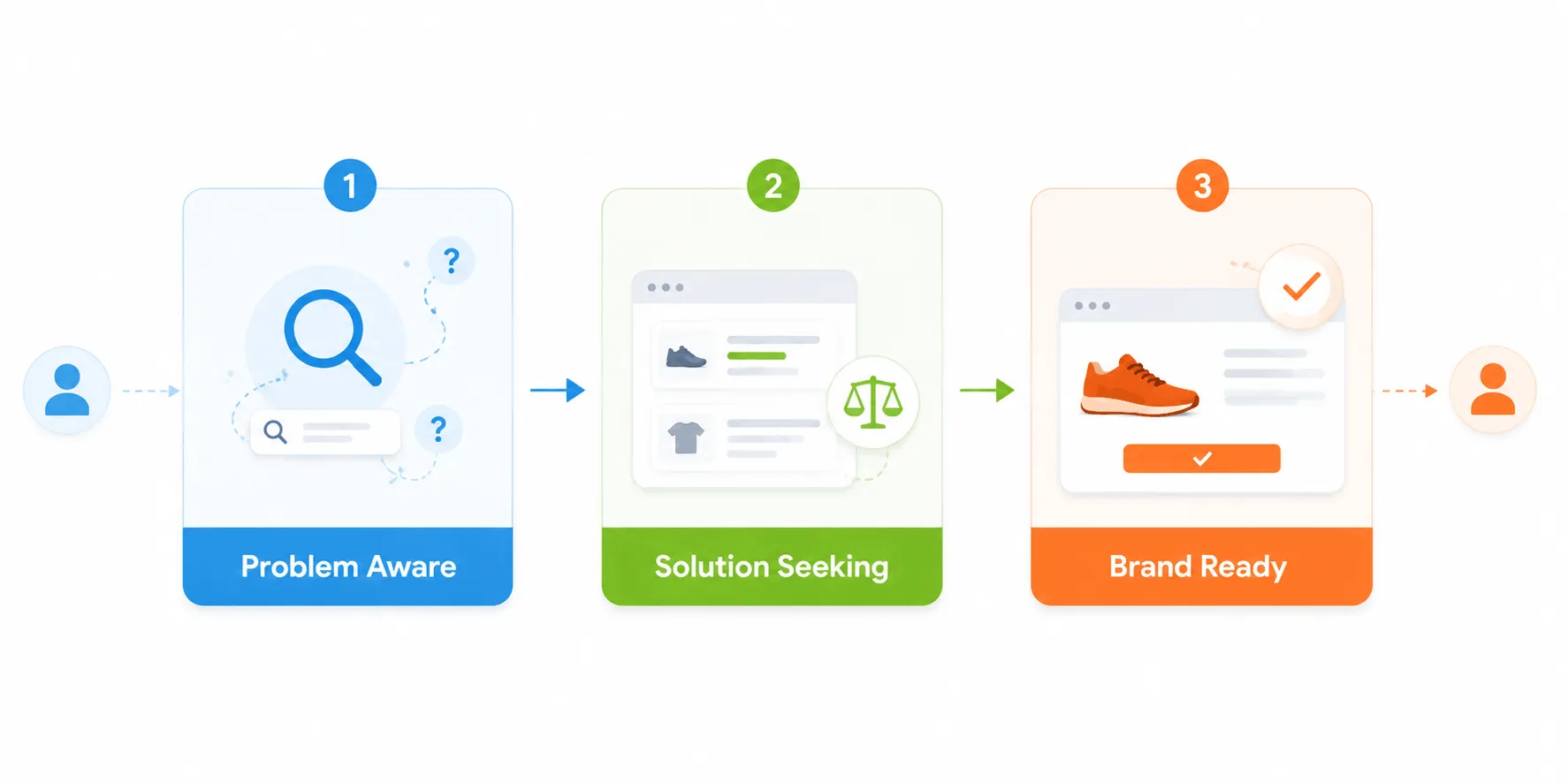
One effective approach is grouping campaigns by intent stage, rather than only by product category. This helps distinguish between users who are early in the journey and those ready to convert.
For example:
- Problem-aware campaigns focus on users exploring a need or issue
- Solution-seeking campaigns target users comparing options
- Brand-ready campaigns capture high-intent users close to conversion
This structure improves how automated bidding systems interpret conversion signals, allowing better budget allocation between discovery and high-value actions.
Landing pages are not just conversion points—they are also data sources that feed back into campaign optimization. High-performing systems treat them as part of a continuous feedback loop.
Feedback Loop:
- Ad Signal: what the user clicked
- Context Match: whether the landing page headline aligns with the ad
- Behavioral Data: scroll depth, engagement, or heatmap interaction
- Bidding Adjustment: feeding engagement signals back into AI systems to improve targeting and find similar users
Measurement needs to be layered as well. Relying only on platform data can lead to overestimation, so combining it with analytics and backend revenue data provides a more reliable view.
Decision Thresholds
Clear decision rules help guide optimization:
- Scale campaigns when performance remains stable for several days and aligns across different data sources
- Adjust or pause when CPA consistently exceeds targets or conversion rates decline
Over time, performance improves through iteration—refining keywords, updating creatives, and improving landing pages.
The goal is not to optimize individual campaigns in isolation, but to improve how the entire system performs.
How Is AI Changing PPC Performance Marketing?
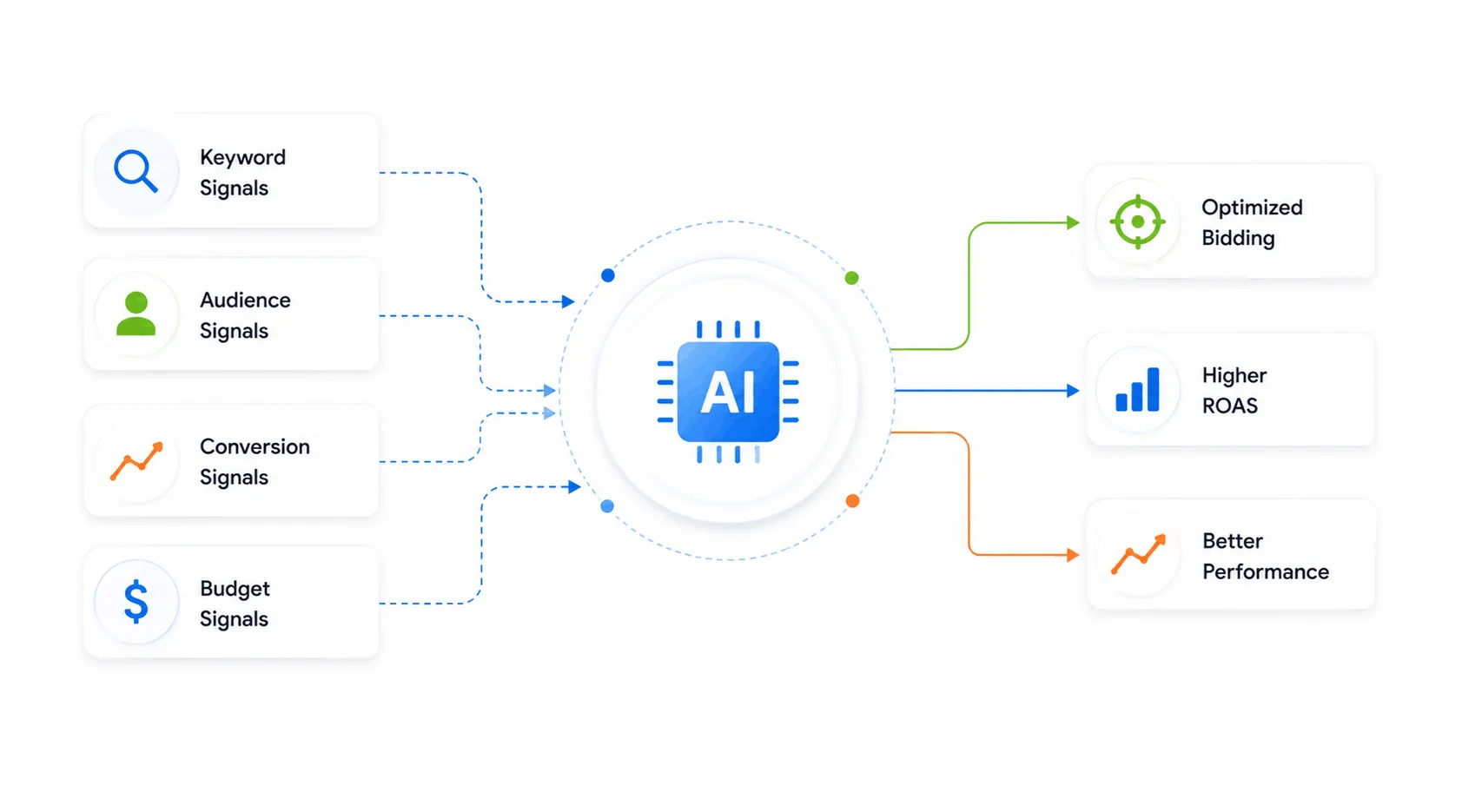
AI is changing PPC performance marketing by automating bidding, targeting, and ad delivery. Instead of manually adjusting campaigns, advertisers now influence performance through the inputs they provide.
This is reflected in platforms like Google Ads Performance Max (PMax), Meta Advantage+, and Microsoft Advertising Predictive Targeting, where optimization is driven by automated systems rather than manual control.
Performance is increasingly shaped by:
- keyword and audience signals
- conversion data quality
- campaign structure and budgets
AI is also used to generate and test ad creatives, not just optimize delivery. This introduces prompt engineering for ads, where marketers guide AI systems to produce variations of headlines, descriptions, and visuals. Performance increasingly depends on how well these creative inputs are structured.
This shifts the role of marketers. Instead of focusing on manual adjustments, the focus moves toward improving inputs—especially tracking accuracy, keyword structure, and landing page performance.
The trade-off is reduced transparency. Campaigns may perform well, but it is not always clear which specific factors drove the results.
What Are the Common Challenges in PPC Performance Marketing?
PPC performance marketing operates within constraints that cannot be fully removed.
Data inconsistency is one of the main challenges. Different platforms report different results, and those numbers rarely align perfectly.
Privacy changes have reduced the amount of trackable data, which means a growing portion of conversions is estimated rather than directly observed.
Other ongoing challenges include:
- rising competition and increasing cost per click
- limited visibility into cross-device behavior
- creative fatigue, where repeated exposure reduces engagement and lowers performance over time
These are not temporary issues. They are part of how modern PPC systems function. The goal is to build processes that account for them rather than relying on perfect data.
CONCLUSION
PPC performance marketing is not just about ads or bids. It is a system shaped by how targeting, tracking, and conversion work together.
Search and display don’t operate in isolation, and neither do the metrics used to evaluate them. Much of what looks like performance is influenced by partial data and automated systems filling in the gaps. That’s why results often feel inconsistent.
The goal isn’t perfect measurement. It’s understanding how the system behaves, validating trends across data sources, and improving what actually drives outcomes over time.
FAQ
What is PPC performance marketing?
It is a paid advertising approach where campaigns are optimized based on measurable outcomes like clicks, conversions, or revenue.
What is a good ROAS for PPC campaigns?
Most campaigns fall between 2x and 4x ROAS, depending on margins and competition.
Why do search ads perform better than display ads?
Search targets users with existing intent, while display supports earlier stages of the buying process.
How important are landing pages in PPC?
Landing pages directly affect conversion rate and can significantly impact overall ROI.
Why don’t PPC metrics match across platforms?
Because each platform uses its own attribution model and may estimate conversions differently.
Read These Next
Marketing Automation Workflow: How to Design High-Converting Sequences from Scratch