.png)
.webp)
SaaS Growth Strategy: The Ultimate Playbook for Scaling Your MRR in 2026
.png)

.png)

What is MRR in SaaS Growth for 2026?
Monthly Recurring Revenue (MRR) in 2026 is the predictable income generated through a hybrid of consumption-based pricing models (where users pay for actual usage) and AI Credits—digital tokens used to pay for specific tasks performed by AI Models. This consumption-based model ensures that revenue scales in proportion to the computational work performed, effectively balancing infrastructure costs against customer value to drive Net Revenue Retention (NRR).
In 2020, SaaS worked similarly to gym memberships, where you pay a flat fee to enter. In 2026, SaaS operates like an electric utility, where users have a base connection fee, but you pay for the actual 'kilowatts' (called credits) of AI work you consume.
Key Takeaways
The 2026 SaaS landscape requires a strategic shift from simple software sales to integrated, high-value systems.
Success is built on three main pillars:
- Hybrid Growth: Combining automated self-service (Product-Led Growth) with human-led expert sales (Sales-Led Growth) to capture both micro-tools and enterprise accounts.
- AI Visibility: Shifting discovery efforts toward Generative Engine Optimization (GEO) to ensure AI assistants recommend your brand to potential buyers.
- Automated Expansion: Utilizing AI agents and machine learning to monitor usage patterns, offer real-time upgrades, and intervene before a customer cancels their subscription.
Article Overview
This playbook explores modern strategies for scaling Monthly Recurring Revenue (MRR) in 2026. It details how to implement hybrid go-to-market motions, optimize content for AI discovery engines, and use AI-driven retention techniques to drive expansion revenue. It also addresses the technical risks of scaling, such as managing high operational costs and excessive unused software within organizations.
Why Stable Monthly Revenue is the Foundation for Scaling
Stable monthly recurring revenue (MRR) is essential for covering the constant data processing and business costs of running integrated AI models in 2026. Without this reliable cash flow, a business cannot maintain modern software's always-on functionality. Consistent revenue demonstrates that the product is a necessity, enabling the company to grow with lessened risk of sudden bankruptcy from variable AI operation costs.
From Seats to Workflows: The New Pricing Model for AI SaaS
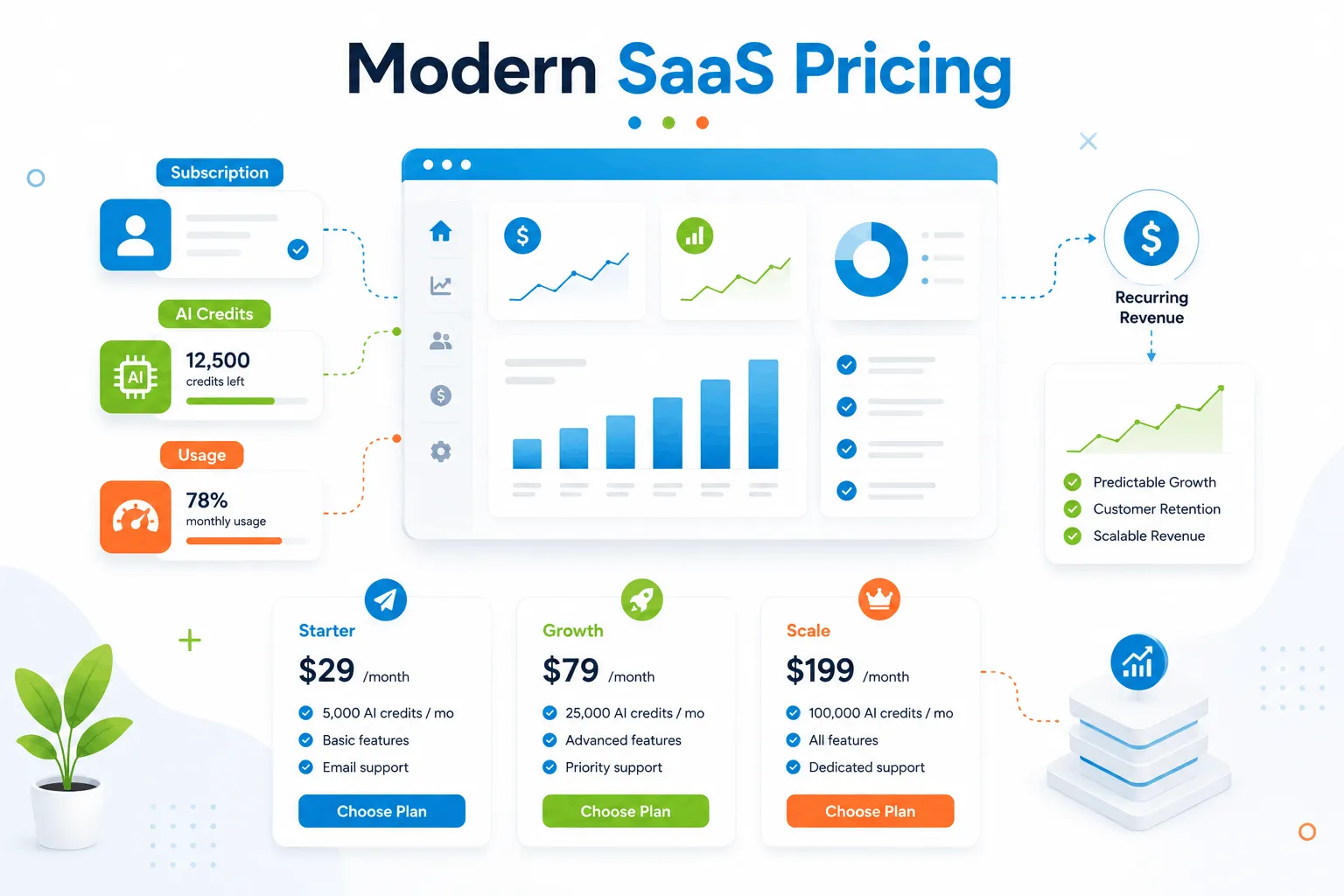
The safest transition for SaaS is to preserve a base subscription while gradually shifting expansion revenue to usage. Instead of charging only by seat, SaaS companies typically charge for the platform, the workflow, and the AI work performed.
The goal is not to abandon subscriptions. It is to combine stable base fees with usage-based expansion.
In traditional SaaS, expansion revenue came from adding users. More employees meant more seats, larger plans, and higher MRR. In AI SaaS, that model is weaker. Customers may need fewer human logins because AI agents now complete more work.
This protects MRR while allowing high-usage customers to expand naturally through credits, compute volume, or automated task completion.
How to Build a Winning SaaS Growth Strategy in 2026
Scaling MRR in 2026 requires moving past simple software sales and into integrated, high-value systems. This section provides a strategic playbook for using hybrid sales, AI search visibility, and advanced retention techniques to grow your revenue.
1. Scaling MRR via Hybrid Go-To-Market (GTM) Motions
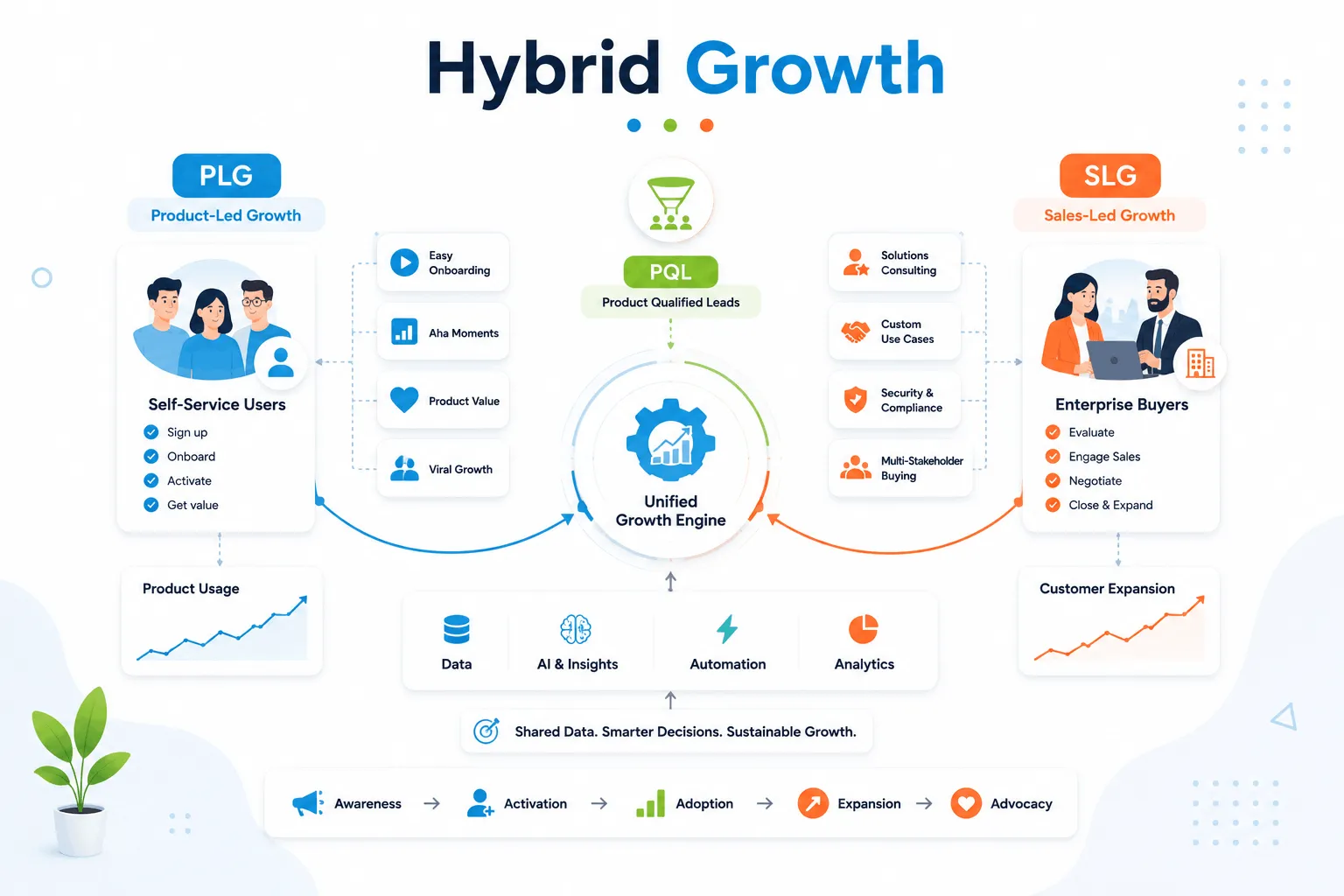
A Hybrid GTM motion is a strategy that uses both automated self-service signups and human-led expert sales. In 2026, the most successful companies do not choose one; they use both to capture different market segments simultaneously.
The Application of PLG and SLG:
- Product-Led Growth (PLG): Use this for micro-tools or entry-level features. Build a loop where a single user can sign up and solve a problem in under five minutes. For example, a design tool might offer one free AI-generated image per day to get users into the platform.
- Sales-Led Growth (SLG): Use this to secure Enterprise accounts. These accounts require human intervention for security reviews and white-glove onboarding, a process where a dedicated specialist sets up the software for the client.
- Actionable Step: Implement a PQL Alert System. A Product Qualified Lead (PQL) is a user who has found value in the free version. For example, program your software to alert a human salesperson when a user hits 80% of their free usage limit. This allows the human to step in exactly when the user is most likely to upgrade.
Case Study: Datadog
Datadog used this hybrid approach to reach $886 million in Q3 2025, incorporating AI observability products, cloud security infrastructures, and user monitoring. They landed small teams through self-service and then used sales experts to expand into full-company contracts, securing 4,060 large enterprise customers.
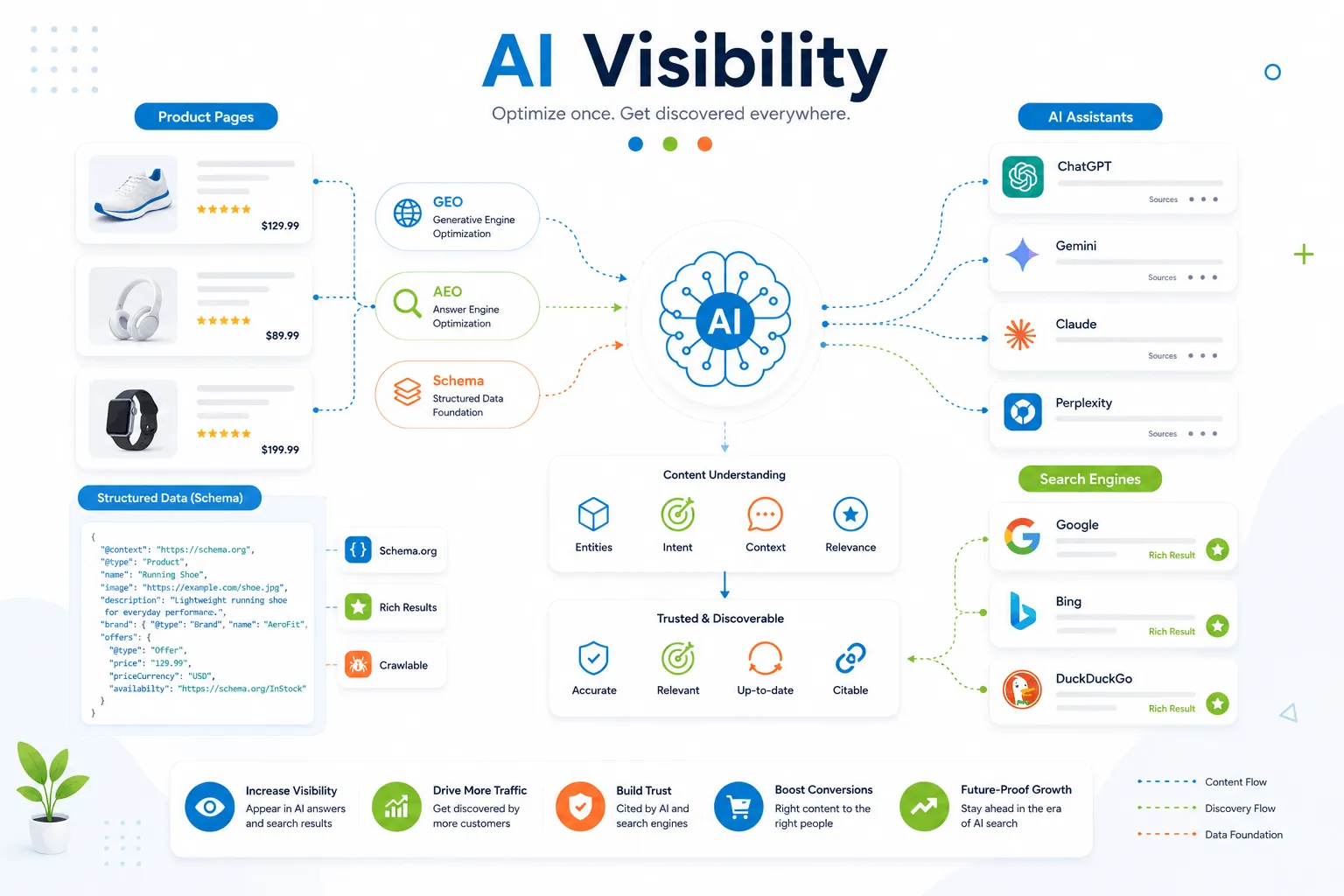
2. Driving Discovery through Generative Engine Optimization (GEO)
GEO is the process of making your website content easy for AI models to read, understand, and recommend. In 2026, most buyers find software by asking an AI assistant for a recommendation.
If AI assistants aren’t mentioning your brand, you risk being overlooked during an increasing portion of the buyer’s research process—even if traditional search, referrals, and word-of-mouth still play a role.
How to Become an AI-Named Authority:
- Answer Engine Optimization (AEO): This is a technical practice where you format your content to answer specific "how-to" questions. Use a Question-Answer structure in your blog posts.
- Optimize for AI Crawlers: AI crawlers are automated scripts that scan the web to train AI models. To help them, use Schema Markup—a piece of code that tells the crawler exactly what your product does and how much it costs.
- The Cite-First Strategy: AI models prioritize citing data with specific numbers. Instead of saying "Our software is fast," say "Our software reduces processing time by 42% according to our 2025 Benchmarking Report." This specific data point is more likely to be cited by an AI as a fact.
- Actionable Step: Create a Technical Wiki on your site. This is a collection of deeply technical, fact-heavy pages that define industry terms. This establishes your brand as the primary source of truth for AI training sets.
Case Study: Major League Baseball (MLB)
Major League Baseball (MLB) in 2026 partnered with Adobe to leverage their Adobe Experience Platform, optimizing their marketing with tools like Adobe GenStudio for content generation and the Adobe LLM Optimizer for improving searchability and observability.
By adding more factual, structured data to their pages, they ensured that when fans asked AI for stats or tickets, MLB's official channels were the top-cited recommendation.
3. Engineering Expansion Revenue with AI-Driven Retention
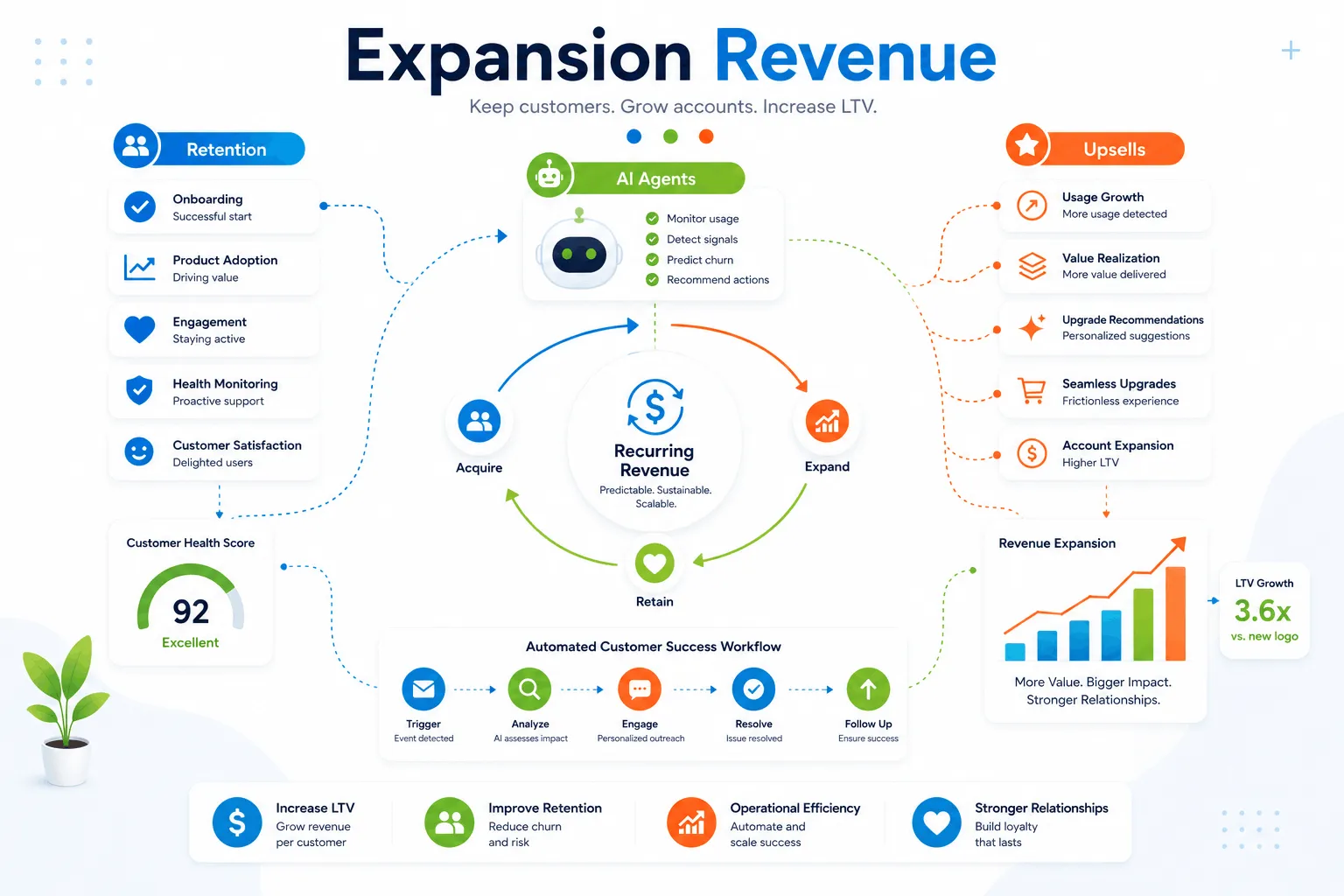
Expansion revenue is the additional money earned from current customers who buy more features. In 2026, this is managed by AI Agents—smart software assistants that monitor customer behavior and suggest upgrades in real-time.
Frameworks such as LangChain and LlamaIndex can help teams build RAG systems and AI agents, but they also introduce new monitoring, security, and cost-control requirements.
Practical Steps for Retaining and Upselling Users:
- Deploying AI Agents: Use a Customer Agent to provide 24/7 support. This agent can identify when a customer is struggling and offer a relevant add-on feature to solve the problem immediately.
- Dynamic Upselling: Set up triggers based on usage. If a customer uses 95% of their AI Credits before the month ends, have an automated system send an email offering a 10% discount on a higher credit tier if they upgrade in the next 24 hours.
- Actionable Step: Audit your churn signals. Churn is when a customer cancels their subscription. Use machine learning to find patterns in customers who leave (such as not logging in for seven days) and have an AI agent reach out with a personalized check-in message to keep them active.
Case Study: IONOS
IONOS used machine learning to look at data from 150 different sources. They predicted what a customer would need next and made specific Next Best Offer suggestions. This doubled their upgrade rates and saved 30% of customers who were planning to leave.
Practical Tools for Smaller SaaS Teams
Small SaaS teams do not need to build every system from scratch. The right tools can support PQL alerts, usage tracking, Schema Markup, AI credits, and customer automation.
From there, the company can add AI infrastructure, compliance tooling, and advanced GEO workflows as revenue and technical maturity increase.
The Hidden Risks of Scaling for SaaS in 2026
The core risk has shifted from underused software to unmanaged automation. In 2026, SaaS companies must track revenue, usage, compute cost, security exposure, and automation-driven seat loss together.
- SaaS Sprawl and Decentralized Inventory
SaaS sprawl is the state where a company possesses an excessive number of software subscriptions that are not tracked by a central authority. This leads to a decentralized inventory, meaning there is no single list or database that shows every active license across the organization.
This lack of oversight creates a risk to scaling because it hides the true cost of doing business, leading to wasted capital on duplicate tools and making it impossible to calculate exact profit margins.
- Shadow AI and Compute Debt
Shadow AI is the use of artificial intelligence tools or automated scripts by employees without prior approval. This results in compute debt, which is the accumulation of unexpected financial obligations caused by the high processing power required to run those hidden AI tasks.
Shadow AI also creates compliance risk. Enterprise buyers increasingly expect vendors to show controls aligned with SOC2, ISO 27001, and internal AI governance policies before approving AI-powered software.
When a company scales, these unmanaged costs can suddenly spike, leading to budget shortfalls and potential data security breaches that the organization is unprepared to handle.
- Compute-to-Revenue Imbalance and Infrastructure Costs
The compute-to-revenue imbalance is a financial state where the cost of the technical infrastructure (the servers, electricity, and data processing) needed to run a product is higher than the money the customer pays to use it.
As AI usage scales, infrastructure costs may become tied to GPU availability, inference volume, and cloud providers running NVIDIA-powered infrastructure.
This risk is tied directly to infrastructure costs, which are the baseline expenses required to host and operate cloud software. If these costs grow faster than sales, scaling the business will actually accelerate its path toward bankruptcy rather than toward profit.
- AI Feature Cannibalization and Value Proposition
AI feature cannibalization occurs when a new, highly efficient automated tool makes an older, more expensive part of the same software suite unnecessary. This forces a company to change its value proposition, which is the specific promise of utility and benefit that makes a customer willing to pay for the product.
If the new AI tool is too good, customers will downgrade their spending, causing a drop in total revenue even as the company provides more technical value.
- Negative Net Revenue Retention and Automation Churn
Net Revenue Retention (NRR) is a percentage that shows how much money is kept from existing customers after accounting for upgrades, downgrades, and cancellations. Negative NRR happens when the money lost from customers leaving or spending less is greater than the money gained from upgrades.
In 2026, this is often caused by automation churn, a phenomenon where clients cancel user seats because AI agents are now doing the work that used to require human logins. This makes seat-based scaling a high-risk strategy as businesses become more automated and require fewer human licenses.
Traditional SaaS Risks vs. AI SaaS Risks
A Quick Checklist for Scaling MRR in 2026
Use this list to ensure your growth strategy is actionable and technically sound.
- Establish a PQL Trigger: Connect your product usage data to your CRM (Customer Relationship Management) tool to alert sales of high-usage free users.
- Update Schema Markup: Ensure your pricing and feature pages use machine-readable code for AI crawlers.
- Launch a Question-Based Blog: Write 10 articles that answer the top "how to" questions in your industry to win in AEO.
- Set Up AI Credit Tracking: Provide a dashboard where users can see their real-time consumption of AI tasks.
Final Thoughts
Scaling MRR in 2026 requires more than adding users. SaaS companies must build pricing, visibility, retention, and infrastructure systems that match how software is now consumed: through AI agents, automated workflows, and usage-based value.
Next Steps:
- Set up a Product Qualified Lead (PQL) alert system to notify sales teams when a user reaches a percentage target of their free usage limit.
- Update pricing and feature pages with machine-readable Schema Markup to ensure visibility to AI crawlers.
- Create a technical wiki or a blog series that answers the top ten "how-to" questions in your industry to establish brand authority.
- Closely track the compute-to-revenue ratio to ensure that the cost of processing power does not outpace income as the user base grows.
Frequently Asked Questions (FAQs)
What is MRR and why is it still important in 2026?
Monthly Recurring Revenue (MRR) is the predictable income a business earns every 30 days from active subscriptions. In 2026, it serves as the essential foundation for covering the high, constant data processing costs associated with running integrated AI models.
How do AI Credits work in modern SaaS pricing?
Many SaaS companies have moved toward consumption-based pricing using AI Credits. These are digital tokens that customers use to pay for specific automated tasks, allowing revenue to scale directly with the value and usage the customer receives.
How can I make sure AI assistants recommend my software?
Implement Generative Engine Optimization (GEO). This involves using structured schema markup code for AI crawlers and adopting a cite-first strategy by publishing specific, factual data points that AI models can easily reference.
Read These Next
Marketing Automation Workflow: How to Design High-Converting Sequences from Scratch