.png)
.webp)
SEO Performance Marketing: The 2026 Playbook for Data-Driven Search Growth
.png)

.png)

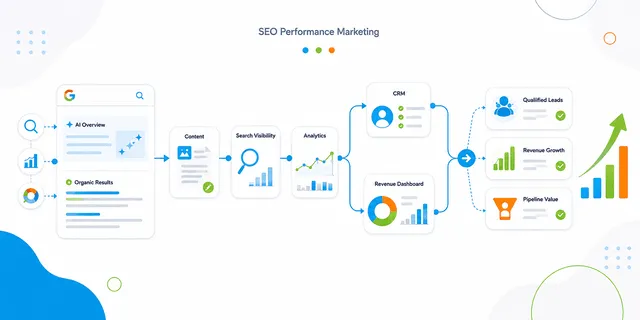
Search engine optimization is no longer measured only by rankings or traffic. Many companies receive organic visits but cannot explain how those visits lead to leads, customers, or revenue. As search behavior changes with AI results, zero-click queries, and multi-platform discovery, SEO must be treated as part of performance marketing, where success is evaluated using business metrics instead of visibility alone.
SEO performance marketing is the use of search engine optimization as a measurable growth channel where results are evaluated using conversions, pipeline, and revenue instead of rankings alone. Following the December 2025 Core Update, search performance increasingly depends on Generative Engine Optimization (GEO), meaning content must be optimized for AI Overviews, Search Generative Experience (SGE), and LLM-based search systems instead of keyword matching alone. This shift moves SEO from keyword visibility to entity-based authority, where performance is measured through analytics, attribution models, and CRM-tracked outcomes.
In modern search environments, discovery may start in Google, AI answers, video platforms, forums, or social media. Because users often visit multiple channels before converting, SEO performance must be evaluated using full-funnel data instead of search reports alone.
This playbook explains how SEO works as a data-driven growth channel in 2026 and how companies connect search visibility with measurable business results.
What This Playbook Covers?
This guide explains how SEO works as a performance marketing channel in modern search environments.
It covers:
- Definition of SEO performance marketing
- Connection between search and revenue
- Changes in modern search
- Metrics that matter
- Full performance system
- Measurement limits
- Execution workflow
1. What Is SEO Performance Marketing?
SEO performance marketing treats search engine optimization as a growth channel tied to measurable business outcomes. Instead of evaluating success using rankings or traffic alone, performance is measured using conversions, qualified leads, pipeline value, and revenue.
To track this properly, search data must be connected with analytics platforms and CRM systems so results can be followed across the entire funnel.
Typical tracking setup includes:
- Google Analytics 4 — tracks visits, engagement, and events
- Google Search Console — shows impressions, clicks, and queries
- CRM platforms (HubSpot, Salesforce) — store leads, opportunities, and revenue
- Conversion tracking — records demos, sign-ups, and form submissions
- Reporting dashboards / BI tools — connect marketing data to pipeline
This setup allows companies to measure the full path from search visibility to revenue instead of looking at rankings alone.
Organic search performance is rarely immediate. Traffic may influence a conversion without being the final step, and results often appear slowly because indexing, ranking, and user behavior change over time. Because of this, SEO performance is usually evaluated using long-term data and full-funnel reporting instead of short-term traffic changes.
2. Why SEO Works Differently in 2026
Search performance changed because discovery no longer happens only inside Google. Users now move across platforms, devices, and AI tools before converting, which makes traditional SEO metrics incomplete.
Major changes affecting performance include:
- AI-generated answers — summaries appear directly in results pages
- Zero-click searches — users often get answers without visiting a site
- Multi-platform discovery — search happens on Google, YouTube, Reddit, TikTok, and AI tools
- Fragmented customer journeys — conversions happen after several visits
- Content saturation — more pages competing for the same queries
- Weaker attribution — tracking systems cannot always identify the real source
What are Fragmented customer journeys?
Modern journeys are rarely linear. A user may discover a topic through an AI answer, read a blog, watch a video, search the brand later, and convert after multiple visits.
Examples:
AI Overview → article → YouTube → brand search → demo → deal
TikTok → Google search → blog → return visit → signup
Forum → brand search → landing page → email → conversion
Because users switch platforms and devices, one analytics report cannot show the full path.
Weaker attribution
Conversions are harder to track today because:
- privacy restrictions reduce tracking accuracy
- cookies expire or are blocked
- users switch devices
- AI answers may influence decisions without clicks
- direct traffic hides the original source
- multiple channels influence one conversion
Because attribution is less reliable, companies often use several methods together to understand performance instead of relying on one report.
Common approaches include:
- First-party data tracking — storing user activity directly in analytics or CRM systems
- Marketing Mix Modeling (MMM) — estimating channel impact using statistical models
- Incrementality testing — testing whether SEO actually causes growth
- CRM pipeline reporting — measuring performance using leads and revenue
- Entity / intent mapping — analyzing discovery across search, AI, and social platforms
Recent industry studies show that about 58.5% of Google queries end without a click, mainly due to AI Overviews, featured snippets, and instant answers. Because of this, traffic alone is no longer a reliable performance metric.
Pro tip (2026):
Modern SEO reports should include pipeline value and revenue influence, not only rankings.
3. How SEO Performance Marketing Works (Full System)
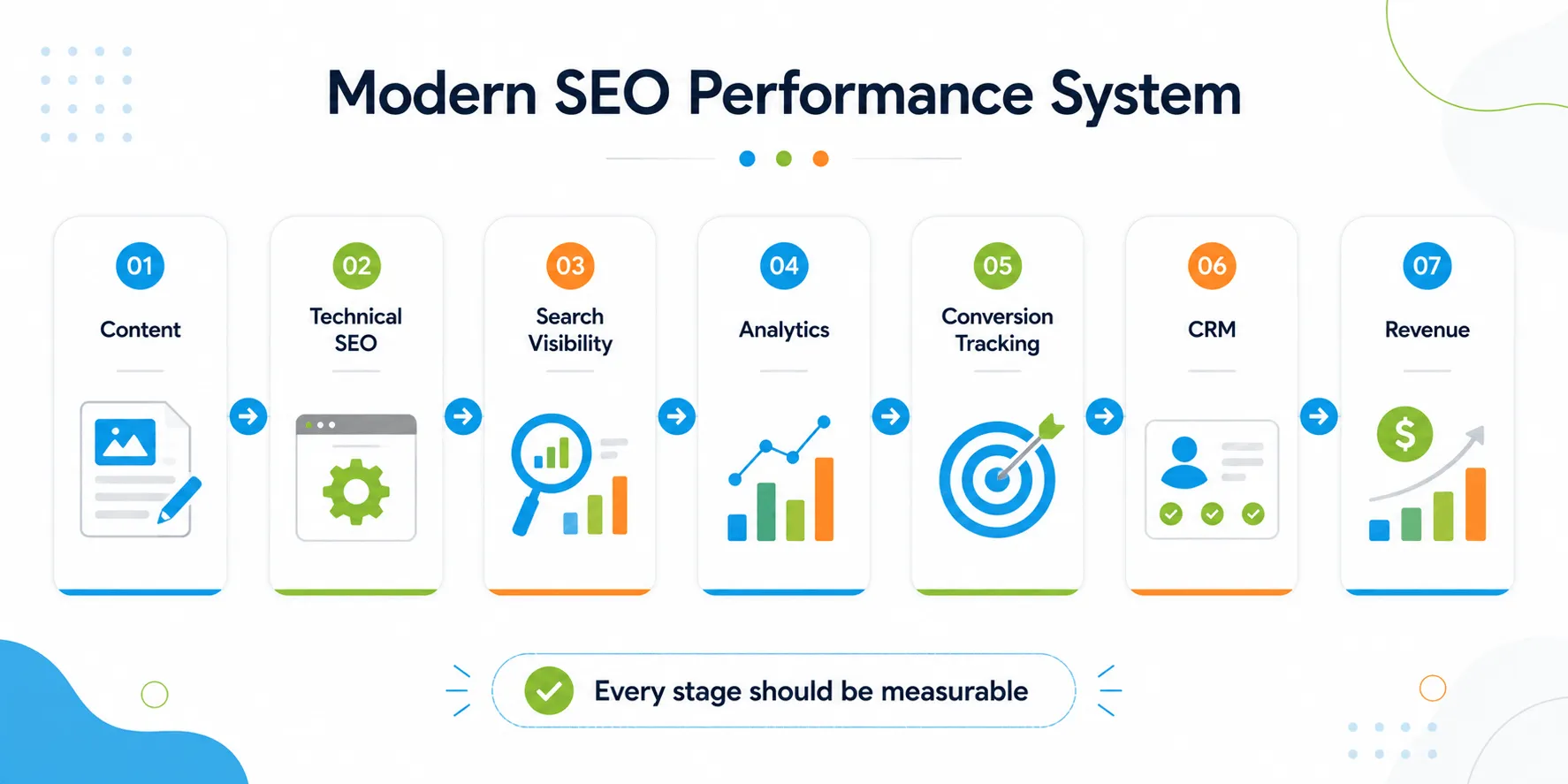
Modern SEO works as a connected system where search visibility, analytics, conversion tracking, and CRM data are linked so results can be evaluated using business outcomes.
Older model:
Search → Click → Page → Conversion → CRM → Revenue
This assumes a direct path, but modern journeys are fragmented.
A typical 2026 journey may look like:
AI Overview → article → video → brand search → landing page → demo → CRM → deal
Another common path:
Social discovery → Google search → blog → return visit → direct → conversion
Because discovery can start in AI answers, forums, or social platforms, performance cannot be measured using search data alone.
Typical performance system includes:
- Content targeting search intent
- Technical SEO for crawling and indexing
- Analytics tracking (GA4, Search Console)
- Conversion tracking and events
- Attribution models
- CRM systems (HubSpot, Salesforce)
- Reporting dashboards or BI tools
Some companies also monitor AI visibility using SGE, LLM tools, or search entity data to understand how content appears in modern search environments.
Performance should be evaluated across the full system, not only ranking reports.
4. What Metrics Matter in SEO Performance Marketing
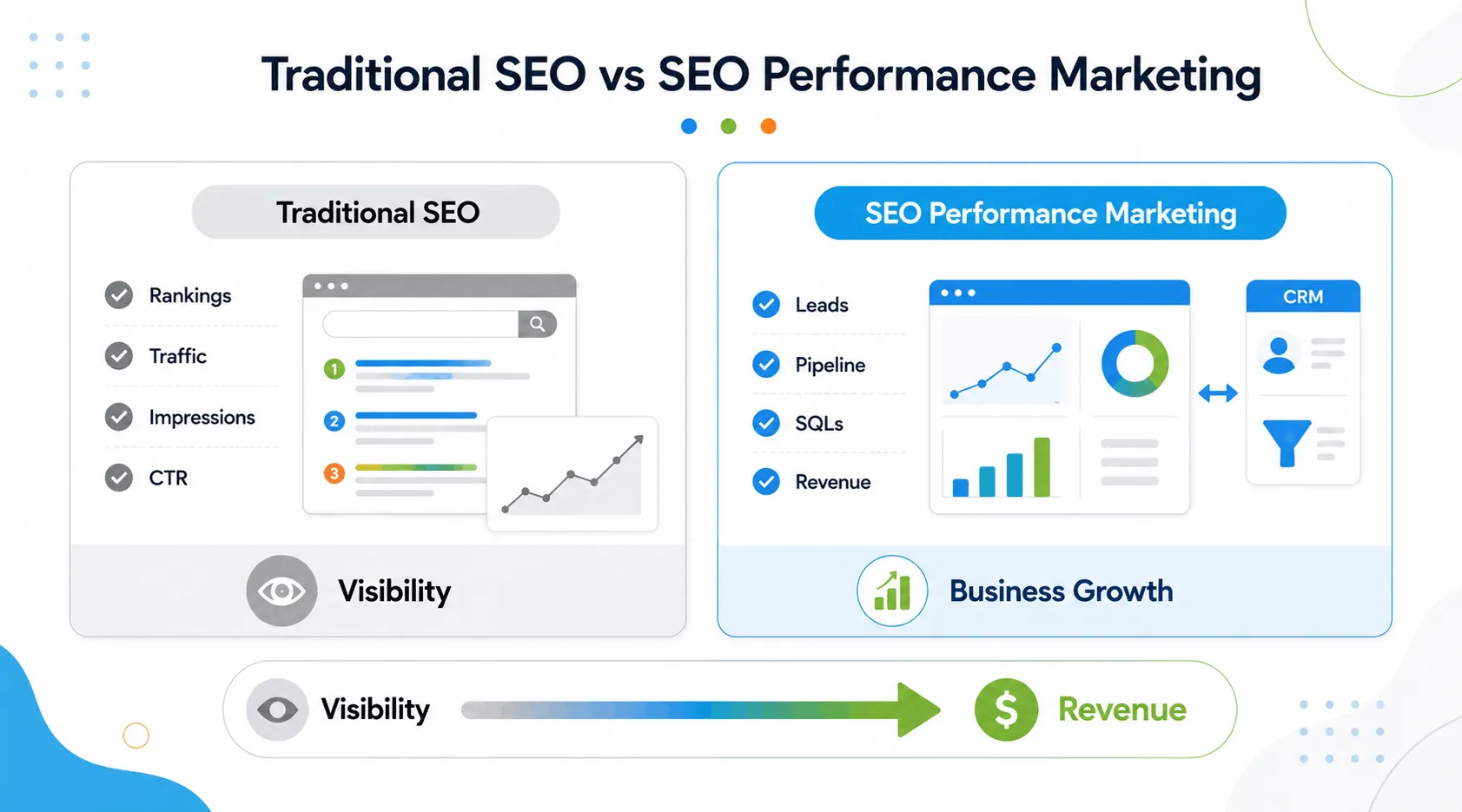
Rankings and traffic show visibility, but they do not show business impact. In performance marketing, success is evaluated using metrics that connect search activity to leads, pipeline, and revenue.
Marketing metrics show how visible a page is inside search engines.
Business metrics show whether that visibility produces qualified leads and real revenue.
Reliable reporting usually combines several data sources:
- analytics data to track visits and behavior
- conversion tracking to record actions
- CRM reports to measure pipeline and deals
- revenue data to evaluate actual performance
Because conversions often happen after multiple visits, SEO performance must be evaluated across the full funnel instead of relying on rankings or traffic alone.
5. Step-by-Step Playbook for Data-Driven SEO Growth
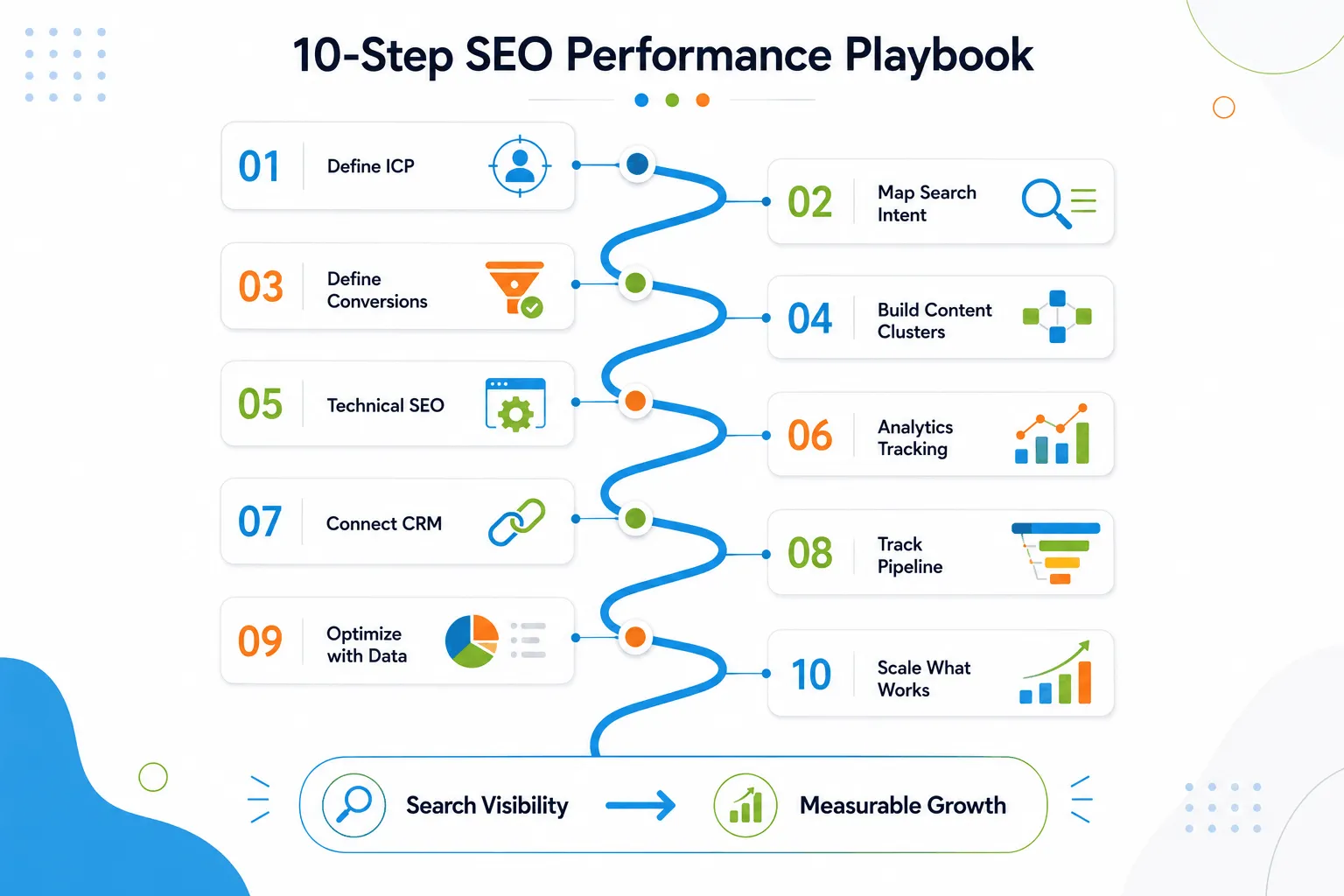
Data-driven SEO growth follows a structured process where search visibility, analytics, and CRM data are connected before scaling traffic. Instead of publishing content and hoping for rankings, companies build systems that allow them to measure how organic search contributes to leads, pipeline, and revenue.
A typical workflow includes the following steps:
- Define ICP — identify the industries, roles, or customer types that convert into qualified leads or revenue
- Map search intent — group keywords by informational, commercial, and transactional queries to match user intent
- Define conversions — decide which actions count as success, such as sign-ups, demos, SQL, or closed deals
- Build content clusters — create related topic pages connected by internal links instead of isolated articles
- Fix technical SEO — ensure pages can be crawled, indexed, and loaded correctly
- Set analytics tracking — track visits, events, and user behavior using analytics tools
- Connect CRM — send leads to systems like HubSpot or Salesforce to track opportunities and revenue
- Track pipeline and revenue — evaluate performance using business data, not only search reports
- Optimize using data — improve pages based on conversion, engagement, and pipeline results
- Scale what works — expand topics that produce measurable business outcomes
This workflow ensures that SEO growth is repeatable and measurable, which is necessary in modern search environments where traffic alone does not show real performance.
6. What Are the Modern Limits of SEO Performance Marketing?
SEO performance is harder to measure today because search behavior, algorithms, and tracking systems have changed. High rankings do not always produce clicks, and traffic does not always lead to revenue.
Common limits include:
- Zero-click results — answers appear directly in search without visits
- AI summaries — users may read the result without clicking
- Content saturation — more pages competing for the same queries
- Algorithm updates — rankings can change suddenly
- Fragmented discovery — users move across multiple platforms
- Weaker attribution — conversions influenced by several channels
- Privacy restrictions — less reliable tracking data
Recent reports on search behavior show that organic visibility is increasingly distributed across AI results, social platforms, and video content. Because discovery can happen outside traditional search results, performance cannot always be measured using search reports alone.
For this reason, SEO should be evaluated using business outcomes such as qualified leads, pipeline, and revenue instead of rankings.
Pro tip (2026):
Teams that connect SEO data with CRM and revenue reports can still measure performance even when attribution is incomplete.
Conclusion
SEO performance marketing works best when search is treated as part of a full performance system rather than a standalone channel. Modern search includes AI answers, zero-click results, and multi-platform discovery, which makes customer journeys more fragmented and harder to measure.
Companies that connect content, analytics, and CRM data can evaluate SEO using leads, pipeline, and revenue instead of visibility metrics. When search visibility is tied to real business outcomes, SEO becomes a predictable growth channel instead of an unreliable source of traffic.
Read These Next
Marketing Automation Strategy: A Step-by-Step Guide