.png)
.webp)
Video Performance Marketing: Crafting Ads That Stop the Scroll and Drive Sales
.png)

.png)

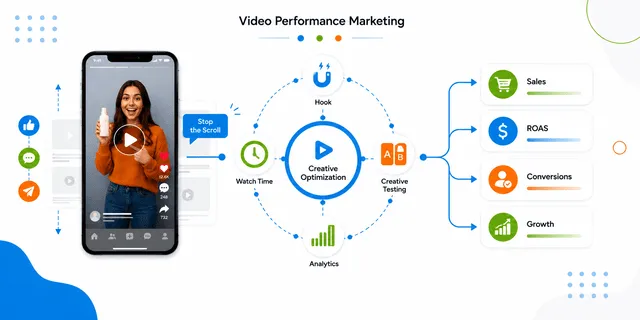
Video performance marketing is a data-driven approach where video creative is optimized for direct conversions such as sales or leads instead of views alone. In modern feed-based platforms, success depends on strong hooks, high hold rates, and thumb-stopping visuals that signal engagement to the algorithm and allow ads to scale delivery based on user interaction.
Video has become the dominant format in paid advertising because most digital platforms are built around scrolling feeds where users decide in seconds whether to keep watching or move on.
As competition increases on Meta, TikTok, YouTube, and other platforms, performance often depends less on targeting and more on creative quality. Many campaigns get views but fail to generate sales because the video does not hold attention long enough to generate engagement signals such as watch time, clicks, or conversions, which platforms use to decide delivery.
Video performance marketing treats video as part of performance advertising rather than only branding. Ads are evaluated using metrics like conversion rate, cost per acquisition, and return on ad spend. This guide explains how video ads work in modern feed-based algorithms, what makes a video stop the scroll, and how performance teams build creatives that can be tested, optimized, and scaled.
What This Guide Covers?
This guide explains how video is used as a performance marketing channel in modern advertising platforms.
It covers:
- what video performance marketing means
- why video ads work differently today
- what makes ads stop the scroll
- how video fits the marketing funnel
- workflow for performance video ads
- tools used in video performance marketing
1. What Is Video Performance Marketing?
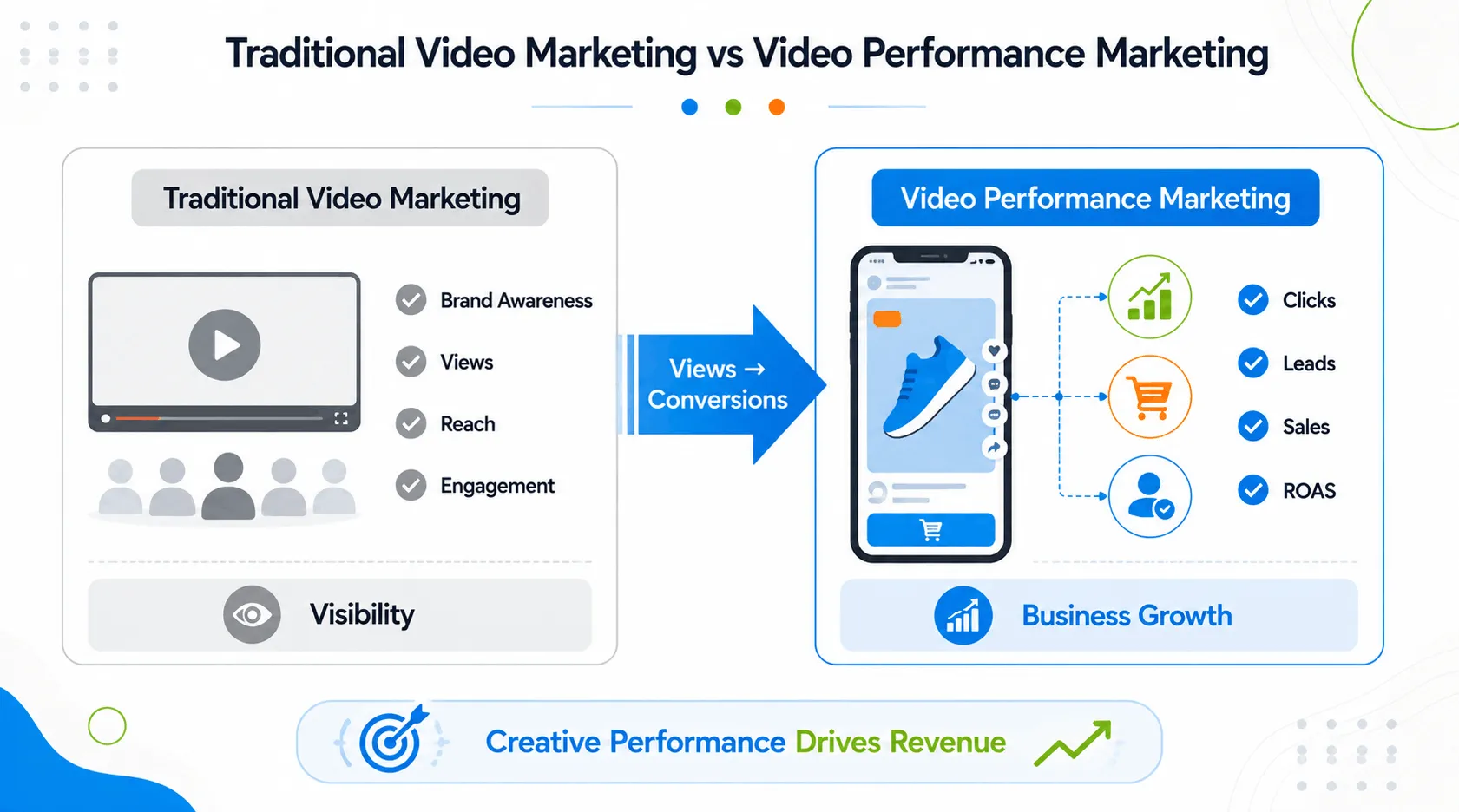
Video performance marketing is the use of video ads designed to generate measurable results such as clicks, leads, or sales instead of only views or brand awareness. In performance marketing, video is treated as a conversion tool, meaning campaigns are evaluated using business metrics rather than engagement alone.
Unlike traditional brand advertising, performance video is optimized using signals that help platforms decide how widely the ad should be delivered. Algorithms in platforms like Meta Ads, TikTok Ads, YouTube Ads, and Google Ads rely on engagement and conversion data to determine whether a video should receive more impressions or budget.
Common performance metrics include:
- click-through rate (CTR)
- conversion rate
- cost per acquisition (CPA)
- return on ad spend (ROAS)
- revenue or sales
Foundational research from Meta Marketing Science (2023) shows that creative quality can drive more than 50% of campaign performance in conversion campaigns. In this context, creative quality refers mainly to how clearly the hook, message, and offer communicate value rather than production quality alone.
In our testing across Meta and TikTok campaigns, video ads that show the product quickly, explain the benefit early, and keep a clear message usually perform better than ads that focus only on visuals or branding. However, creativity is only one part of performance. Results also depend on targeting, offer, landing page, and tracking setup, so video quality matters most when the rest of the system is already working.
2. Why Video Ads Work Differently in 2026
Video ads perform differently today because most advertising platforms use feed-based algorithms that prioritize engagement, watch time, and interaction instead of simple impressions. Foundational reports such as HubSpot’s State of Marketing Report (2024) show that short-form video consistently delivers the highest ROI among social formats, which explains why most platforms now prioritize video in feed-based delivery systems.
Several changes affect how video ads perform today:
- short-form video dominates most paid feeds
- scrolling behavior reduces attention time
- delivery depends on engagement signals
- content saturation increases competition
- UGC-style ads often outperform polished ads
- AI tools make content easier to produce
Modern platforms reward videos that keep attention, not just videos that get views. Metrics such as hold rate, watch time, and interaction often determine whether an ad continues to receive delivery.
We have observed across Meta and TikTok campaigns that ads with strong first-second hooks often scale faster even with smaller budgets, while high-production videos without a clear opening may fail to deliver.
Platform-native style
Platform-native style means the video looks similar to organic content normally seen on the platform instead of traditional commercials. This often includes vertical format, fast pacing, subtitles, simple editing, and a person speaking directly to the camera. Ads that match the natural style of the feed usually perform better because users do not immediately recognize them as ads.
Common patterns in modern video ads:
- the first seconds determine delivery
- vertical format is standard
- fast pacing improves hold rate
- subtitles help silent viewing
- UGC-style videos feel more natural
- creative fatigue happens faster
Because of this, performance video marketing depends heavily on creative testing, not only targeting.
3. What Makes a Video Ad Stop the Scroll
A video stops the scroll when the first seconds create enough curiosity, emotion, or relevance to make the viewer keep watching. In feed-based platforms, the hook determines whether the algorithm continues showing the ad, which means creative structure directly affects delivery, cost, and conversion rate.
Important creative elements include:
- hook in the first seconds
- movement or visual change
- clear problem or message
- fast pacing
- simple visual style
- on-screen text or captions
- human face or voice
- UGC-style presentation
Common patterns in high-performing ads:
- strong first 1–3 seconds
- frequent cuts or motion
- subtitles for silent viewing
- problem shown early
- real person speaking
- format similar to organic posts
Performance often follows this pattern:
- hook → engagement
- engagement → delivery
- delivery → performance
Foundational research from TikTok Marketing Science (2023) shows that ads capturing attention in the first three seconds are significantly more likely to be watched and converted. In our testing, videos that show the result or problem immediately usually generate higher hold rate and lower cost per acquisition than slow-intro ads.
High production quality is not required for performance. Videos that feel natural, fast, and clear often outperform polished ads because they match how users normally consume content in scrolling feeds.
4. Full-Funnel Video Strategy (TOF / MOF / BOF)
Video performance marketing works best when different videos are used for different stages of the funnel instead of trying to make one ad do everything. Users at the awareness stage behave differently from users ready to buy, so video content must match intent to produce conversions.
Basic funnel structure:
Different types of video are used at each stage:
TOF — awareness
- short videos
- strong hooks
- UGC style
- trend / feed-native content
MOF — consideration
- demos
- comparisons
- problem–solution videos
- product explanation
BOF — conversion
- testimonials
- offers
- case studies
- guarantees
- direct-response ads
In our testing across Meta and TikTok campaigns, ads that match the user’s intent stage usually scale more consistently. Awareness videos often get cheap views but poor conversion, while direct-response ads may fail if shown to cold audiences.
Foundational reports such as Wyzowl’s Video Marketing Statistics (2024) show that pages using video often convert better than text-only pages, which is why video is frequently used in middle- and bottom-funnel campaigns.
.webp)
5. Step-by-Step Workflow for Performance Video Ads
Performance teams use a structured workflow to create video ads that can be tested, optimized, and scaled using measurable results. Platforms such as Meta Ads and TikTok Ads rely on engagement and conversion data, which means creative testing must happen continuously to avoid fatigue.
Typical workflow used in performance video marketing:
- Define the goal — decide whether the video should generate clicks, leads, or sales.
- Define the audience — identify who the ad is for and where it will appear.
- Define the conversion event — purchase, signup, demo, or add-to-cart.
- Create multiple hooks — different openings often produce very different results.
- Produce several variations — change visuals, text, or message.
- Launch, test, and compare — use CTR, hold rate, CPA, and ROAS to evaluate.
- Scale winning creatives — increase budget only after stable performance.
In our experience running Meta and TikTok campaigns, the biggest performance gains usually come from testing new hooks rather than changing targeting. Videos often stop scaling because of creative fatigue, not because the audience is exhausted.
6. Tools for Video Performance Marketing
Performance video ads are created, tested, and optimized using tools for ad delivery, editing, and tracking. Platforms such as Meta Ads, TikTok Ads, CapCut, Premiere, ChatGPT, GA4, and Shopify are commonly used to produce creatives, launch campaigns, and measure which videos generate real conversions.
Ad platforms
- Meta Ads / TikTok Ads — main platforms for feed-based conversion ads
- YouTube Ads / Google Ads — intent-driven and video campaigns
These platforms optimize delivery based on signals such as watch time, CTR, CPA, and ROAS, so creative quality directly affects performance.
Creative tools
- CapCut / Premiere / After Effects — editing and motion
- Canva / Descript / Runway — fast variations and captions
- ChatGPT — hooks, scripts, UGC prompts, ad angles
Performance teams often create multiple versions of the same video because testing different hooks usually improves results.
Example workflow
A common workflow used by performance teams:
- generate 10 hook ideas in ChatGPT
- edit variations in CapCut
- export multiple versions
- launch in Meta Ads or TikTok Ads
- track results in Ads Manager and GA4
- scale the best creative
Testing several variations of one idea usually performs better than producing one high-budget video.
Tracking and analytics
- GA4 — behavior after click
- Ads Manager / TikTok Manager — ad metrics
- Looker / Supermetrics — combined reports
- Shopify / HubSpot — real sales or leads
Tools help run campaigns, but results depend on creative testing, correct tracking, and clear conversion goals, not the software itself.
Conclusion
Video is now a performance marketing channel, not only a branding format. Feed-based platforms reward content that keeps attention and generates engagement, which means creative structure directly affects delivery, cost, and conversion rate.
Scaling video ads usually requires a system that includes clear goals, multiple creatives, reliable tracking, and ongoing testing. When creative, data, and optimization work together, video can become one of the most effective ways to drive measurable results, but performance still depends on the offer, the audience, and continuous experimentation.
Read These Next
B2B Marketing Attribution: A Complete Guide for Modern B2B Teams