.png)
.webp)
Ways to Improve Marketing Performance: 11 Tactics for Immediate Results
.png)

.png)

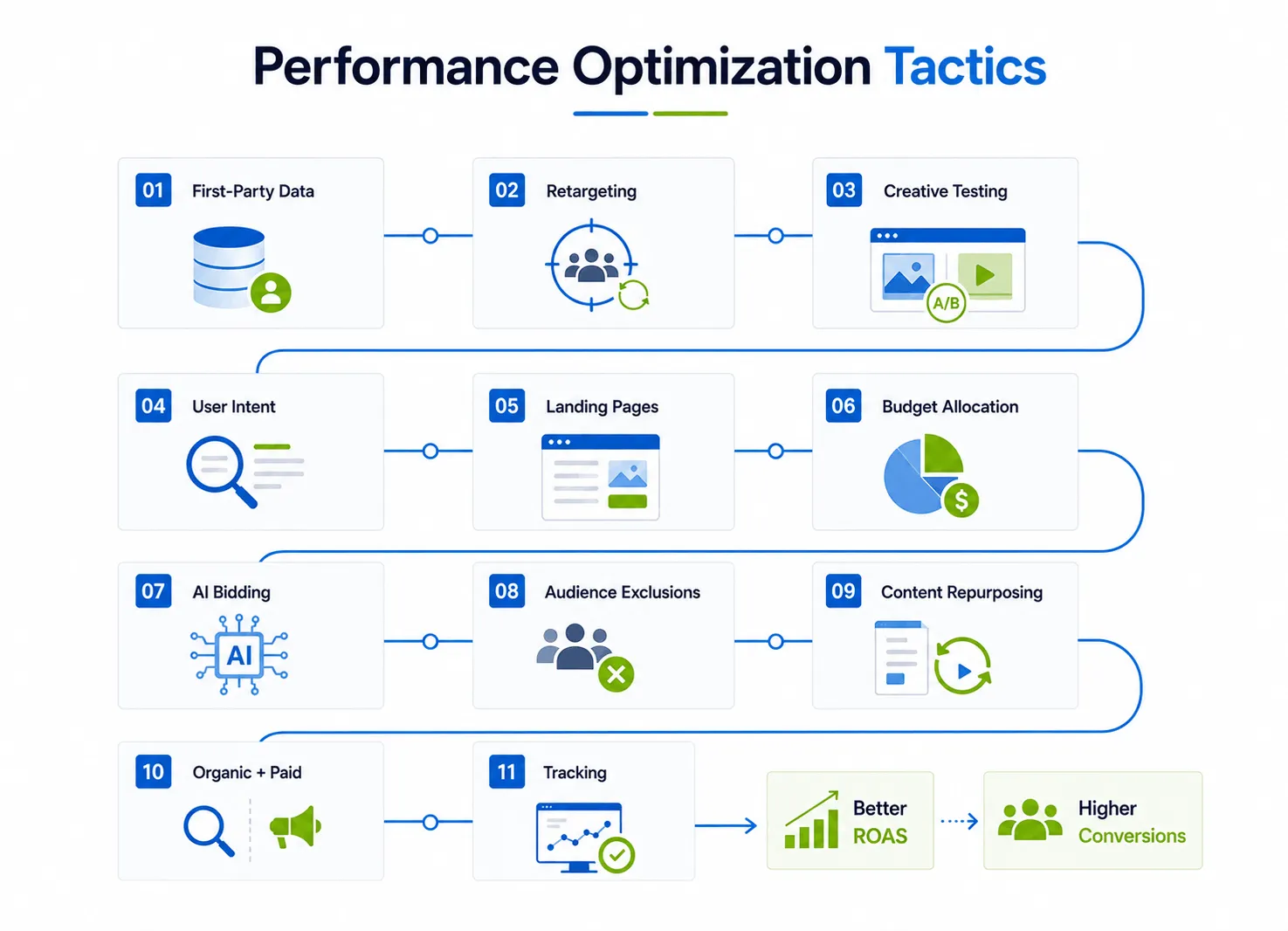
Improving performance marketing requires structured optimization across targeting, creatives, budget allocation, and tracking. The most effective improvements come from reducing inefficiencies rather than increasing spend. This guide outlines 11 practical tactics that improve conversion rates, reduce wasted budget, and increase return on ad spend (ROAS) using data-driven and AI-supported strategies.
INTRODUCTION
To improve performance immediately, shift to a first-party data strategy to offset third-party cookie loss, implement AI-driven automated bidding (tCPA/tROAS), and increase creative testing frequency to prevent fatigue. Focus on improving landing page conversion rates and use server-side tracking to maintain data accuracy in privacy-first environments.
Performance marketing is designed to produce measurable results such as clicks, leads, and conversions. However, many campaigns fail to reach their full potential due to inefficient targeting, weak creative execution, or incomplete tracking systems.
In 2026, improving marketing performance is more complex due to three major shifts:
- Privacy-first ecosystems limiting third-party data
- AI-driven ad platforms automating decisions
- Multi-channel journeys where users interact across several touchpoints
This means performance improvements no longer come from a single change. Instead, they come from system-level optimization across the entire funnel.
Industry research and platform data consistently show that campaigns using structured testing, segmentation, and performance tracking achieve stronger ROI compared to campaigns relying on broad targeting or static creatives (Amazon Ads, 2024; Directive, 2026).
WHAT THIS GUIDE COVERS
This guide explains how to improve performance marketing using practical, immediately applicable tactics.
It covers:
- How to improve targeting and audience efficiency
- How to increase engagement through creative optimization
- How to improve conversion rates without increasing traffic
- How to allocate budget more effectively
- How AI and privacy changes impact performance
Why Marketing Performance Declines (Even With Budget)
Marketing performance does not usually decline because of low budget. In most cases, it declines due to inefficiencies within the campaign structure.
The most common issues observed in performance audits include (based on audits of 50+ campaigns across different industries):
- overly broad audience targeting
- running the same creatives for too long
- weak or misaligned messaging
- incomplete or inaccurate tracking
- scaling campaigns before validation
These issues lead to:
- higher cost per acquisition (CPA)
- lower conversion rates
- wasted impressions
As highlighted in media buying audits, we’ve found that inefficient allocation and lack of structured testing are more common causes of underperformance than budget constraints.
Improving performance requires identifying and fixing these inefficiencies first.
11 Tactics to Improve Performance Marketing Immediately
Tactic #1 — Refine Audience Targeting Using First-Party Data
Broad targeting reduces campaign efficiency because ads are shown to users who are unlikely to convert. Improving targeting accuracy requires using first-party data and intent signals to focus spend on high-probability audiences.
First-party data includes:
- website visitors
- CRM or customer lists
- email subscribers
- past purchasers
These audiences are more valuable because they are based on real interactions, not inferred behavior.
In 2026, this shift is critical. Privacy regulations and the decline of third-party cookies have reduced the effectiveness of external audience data. Platforms now rely more heavily on:
- first-party signals
- platform-side machine learning
- aggregated event data
To improve targeting:
- create segmented audiences (e.g., product viewers vs general visitors)
- build lookalike audiences from high-value users
- exclude low-intent segments
- layer behavioral signals such as engagement or search intent
Campaigns that prioritize high-intent segments typically see:
- higher click-through rates (CTR)
- lower cost per acquisition
- improved ROAS
Tactic #2 — Prioritize High-Intent Retargeting Campaigns
Retargeting is one of the most effective ways to improve marketing performance because it focuses on users who have already interacted with the brand.
Unlike cold audiences, retargeting audiences already demonstrate intent. This makes them:
- easier to convert
- less expensive to acquire
- faster to generate results
Common retargeting audiences include:
- product page viewers
- cart abandoners
- video viewers
- repeat website visitors
- past customers
These users are already familiar with the brand, which reduces the amount of persuasion required.
Performance benefits of retargeting:
- higher conversion rates
- lower CPA
- stronger engagement
- faster campaign validation
However, retargeting depends on having enough data. New campaigns may need to generate initial traffic before retargeting becomes effective.
Tactic #3 — Increase Creative Testing Frequency
Creative is one of the most influential variables in performance marketing. Even with strong targeting, poor creative execution can significantly reduce results.
A common issue is creative fatigue, where performance declines because users have already seen the same ad multiple times.
To improve performance, campaigns must run continuous testing.
Elements to test:
- headlines and hooks
- visual formats (image vs video)
- messaging angles
- call-to-action variations
Testing allows marketers to identify which combinations produce:
- higher engagement
- better conversion rates
- lower cost per result
In structured campaigns, testing is not optional—it is a core part of optimization. Campaigns that continuously test creatives consistently outperform those that rely on a single version.
A practical approach:
- launch multiple variations simultaneously
- identify top performers
- shift budget to winning creatives
- introduce new variations regularly
Tactic #4 — Align Ad Messaging With User Intent
Performance marketing depends heavily on matching the right message to the right audience at the right stage of the funnel.
When messaging is misaligned with user intent, performance drops—even if targeting is correct.
Examples of alignment:
For example:
- Search ads should be direct and solution-focused
- Social ads should capture attention and introduce value
- Retargeting ads should reinforce urgency or trust
Misalignment leads to:
- low CTR
- poor engagement
- high bounce rates
Correct alignment improves both click quality and conversion efficiency.
In 2026, user behavior has shifted toward social search, where platforms like TikTok and Instagram are used to discover products and solutions. This means ad copy and creative should also be optimized for “Social SEO,” using natural language, keyword-aligned messaging, and clear value propositions that match how users search within these platforms.
Social SEO Tip: Instead of keyword-stuffing, focus on 'Natural Language Processing' (NLP)—use the exact phrases your customers use in comments to ensure your ads appear in relevant social search results.
Tactic #5 — Optimize Landing Pages for Conversion
Driving traffic is only part of performance marketing. If the landing page does not convert, ad performance will remain limited regardless of targeting or creative quality.
Landing page optimization focuses on reducing friction and improving clarity.
Key elements:
- headline that matches the ad message
- clear and visible call-to-action
- simple, distraction-free layout
- fast loading speed (especially on mobile)
Even small improvements in conversion rate can significantly impact performance.
For example:
- improving conversion rate from 2% to 3% increases output by 50% without increasing traffic
Common issues that reduce performance:
- mismatch between ad and landing page
- slow page speed
- too many competing elements
- unclear value proposition
Optimizing landing pages is one of the highest-impact ways to improve results without increasing spend.
Tactic #6 — Reallocate Budget to High-Performing Channels
Not all channels deliver the same results. Some platforms are optimized for reach, while others are optimized for conversions.
Performance marketing requires shifting budget toward channels that produce the best outcomes—not the most impressions.
Channel comparison:
Many campaigns underperform because the budget is distributed evenly instead of strategically.
To improve performance:
- identify highest ROAS channels
- reduce spend on low-performing placements
- scale channels with proven results
Industry guides emphasize that channel selection often has a greater impact on performance than budget size.
Tactic #7 — Use AI-Based Bidding and Optimization
AI-driven optimization has become a core component of performance marketing in 2026. Most major advertising platforms now rely on machine learning to adjust bids, allocate budgets, and optimize delivery in real time.
Instead of manually controlling every variable, advertisers now provide:
- campaign objectives
- audience signals
- conversion data
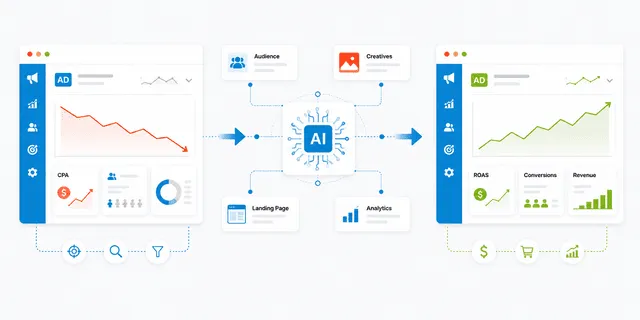
The platform then optimizes performance using conversion probability modeling and agentic AI systems, which continuously adjust bids and delivery based on the likelihood of a user converting.
Common AI-driven systems include:
- automated bidding (e.g., target CPA, target ROAS)
- dynamic audience expansion
- real-time budget reallocation
- predictive conversion modeling
Modern platforms also use agentic AI, where systems autonomously test, learn, and reallocate budget without manual input, making campaign inputs (data quality, creative, structure) more important than manual controls.
Agentic AI evaluates the creative, the landing page, and the audience, and autonomously decides to pause one ad and launch a new variation based on real-time feedback.
These systems improve performance by:
- adjusting bids at scale
- identifying patterns faster than manual analysis
- optimizing across thousands of signals simultaneously
However, AI systems are only as effective as the data they receive.
To improve results:
- ensure accurate conversion tracking
- provide sufficient data volume
- avoid over-segmentation that limits learning
- allow campaigns enough time to exit the learning phase
Industry reports show that modern ad platforms increasingly function as automated optimization systems rather than manual buying tools, requiring advertisers to focus more on inputs (data, creative, structure) than micromanagement.
Tactic #8 — Reduce Wasted Ad Spend With Audience and Placement Exclusions
A significant portion of ad spend is often wasted on users or placements that are unlikely to convert. Reducing inefficiency is one of the fastest ways to improve marketing performance.
Exclusions help prevent budget from being allocated to low-value impressions.
Common exclusion strategies:
- exclude past converters (to avoid redundancy)
- exclude low-engagement audiences
- exclude irrelevant geographic locations
- exclude underperforming placements or websites
Without exclusions, campaigns may:
- repeatedly target users who already converted
- spend on low-quality traffic
- inflate costs without improving results
Benefits of exclusions:
- improved ROAS
- lower CPA
- more efficient budget usage
In performance marketing, improving efficiency is often more impactful than increasing reach. Eliminating wasted spend allows more budget to be redirected toward high-performing segments.
Tactic #9 — Repurpose High-Performing Content Instead of Creating From Scratch
Content production can be resource-intensive, but performance marketing does not require constant creation of new assets. In many cases, repurposing existing high-performing content leads to better results.
This is because proven content already demonstrates:
- audience relevance
- engagement potential
- message clarity
Examples of repurposing:
- long-form video → short-form ads
- blog content → carousel ads
- testimonials → social proof creatives
- organic posts → paid promotions
Advantages of repurposing:
- lower production cost
- faster campaign execution
- higher probability of success
In structured campaigns, scaling proven content is typically more efficient than introducing entirely new, untested creatives.
This approach reduces risk and improves consistency across channels.
Tactic #10 — Combine Organic and Paid Strategies for Better Efficiency
Performance marketing does not operate in isolation. Organic content can significantly improve paid campaign performance when used strategically.
Instead of relying only on paid ads, campaigns can use organic data as a testing layer.
A practical workflow:
- publish content organically
- identify high-engagement posts
- promote top-performing content using paid ads
- scale based on performance
This approach provides several advantages:
- lower testing costs
- validated messaging before ad spend
- higher engagement rates
- reduced creative risk
Organic performance acts as an early indicator of what resonates with the audience.
Campaigns that integrate organic and paid strategies often achieve better efficiency because they reduce reliance on untested assumptions.
Tactic #11 — Improve Tracking and Attribution Accuracy
Accurate tracking is essential for improving marketing performance. Without reliable data, optimization decisions become inaccurate, leading to wasted budget and incorrect scaling.
Modern performance marketing requires more advanced tracking due to privacy restrictions and fragmented user journeys.
Key improvements include:
- implementing first-party tracking systems
- using server-side tracking to reduce data loss
- integrating CRM and offline conversion data
- using multi-touch attribution models
Server-side tracking ensures data accuracy by sending conversion signals directly from your server to the ad platform, bypassing the browser-based privacy filters and ad-blockers that typically break traditional tracking.
Traditional last-click attribution is often insufficient because it ignores earlier touchpoints in the customer journey.
Improved attribution helps:
- identify which channels drive conversions
- allocate budget more effectively
- understand full-funnel performance
Modern ad tech stacks increasingly include attribution and analytics tools that unify cross-channel data, providing a more complete view of performance. In many cases, a growing share of conversions is now modeled rather than directly tracked, which makes accurate tracking infrastructure even more critical for reliable decision-making.
How AI and Privacy Changes Affect Performance Marketing in 2026
Performance marketing in 2026 is shaped by two major forces: automation and privacy regulation.
1. Reduced Reliance on Third-Party Cookies
Tracking user behavior across websites is more limited, which reduces visibility into the full customer journey.
As a result:
- first-party data becomes more important
- contextual targeting gains relevance
- modeled conversions are more widely used
New frameworks such as Google’s Privacy Sandbox and platform-level solutions like Meta Advantage+ Shopping campaigns are reshaping how targeting and measurement work without relying on third-party cookies.
2. Increased Use of AI and Automation
Ad platforms now automate:
- bidding
- targeting
- budget allocation
- creative optimization
This shifts the role of marketers from manual execution to:
- strategy development
- data quality management
- creative direction
3. Growth of Omnichannel Measurement
Users interact across multiple platforms before converting.
Modern performance marketing requires:
- cross-channel tracking
- unified reporting
- attribution models beyond last-click
Many teams now use GA4 with BigQuery exports to analyze high-volume event data and improve cross-channel attribution.
CONCLUSION
Improving performance marketing is primarily about increasing efficiency, not increasing spend. Most campaigns already have the potential to perform better with the same budget by addressing structural inefficiencies.
The most impactful improvements come from:
- refining audience targeting
- continuously testing creatives
- optimizing landing pages
- reallocating budget based on performance
- improving tracking accuracy
In 2026, successful performance marketing strategies are built on:
- first-party data
- AI-driven optimization
- cross-channel measurement
Campaigns that focus on these principles consistently achieve stronger conversion rates, lower acquisition costs, and more sustainable growth.
FAQs
What is performance marketing?
Performance marketing is a strategy where advertisers pay based on measurable outcomes such as clicks, leads, or conversions.
What is the fastest way to improve marketing performance?
Refining targeting, increasing creative testing, and optimizing landing pages are the fastest ways to improve results.
Why does ad performance decline over time?
Performance often declines due to creative fatigue, audience saturation, or lack of optimization.
How can I reduce wasted ad spend?
Use audience exclusions, improve targeting accuracy, and reallocate budget to high-performing campaigns.
Does AI replace manual campaign optimization?
AI automates execution, but marketers still need to manage strategy, data quality, and creative direction.
What metrics should I focus on in performance marketing?
Key metrics include return on ad spend (ROAS), cost per acquisition (CPA), conversion rate, and customer lifetime value
Read These Next
AI Marketing Automation: How to 10x Your Output with Machine Learning