.png)
What is Growth Marketing? - Everything You Need to Know in 2026
.png)

.png)

Growth marketing in 2026 is a technical discipline focused on full-funnel optimization through data-driven experimentation and AI automation. Unlike traditional marketing, it prioritizes customer retention and unit economics (LTV > CAC) over broad brand awareness. It utilizes self-sustaining growth loops and first-party data to drive sustainable revenue in a privacy-first digital era.
Article Overview
This article explains growth marketing in 2026 as a technical field focused on steady revenue through data and testing. It shows how businesses are moving away from brand awareness toward AI systems, growth loops, and retention strategies to handle rising costs and privacy rules.
Key Takeaways
- Growth marketing is now a technical discipline that prioritizes empirical data and mathematical frameworks over creative intuition.
- Due to strict privacy laws (GDPR/CCPA) and the end of third-party cookies, focusing on existing customers is more cost-effective than finding new ones.
- Modern strategies utilize loops where user actions naturally trigger new acquisitions, reducing the need for expensive paid media.
- Automation has shifted from simple triggers to autonomous AI agents that manage budgets and optimize content in real time.
- Success is measured through the AARRR framework—Acquisition, Activation, Retention, Referral, and Revenue.
Why Growth Marketing is a Technical Discipline
Growth marketing follows a scientific approach, using data instead of intuition. In 2026, it involves frequent testing and requires knowledge of math and data systems.
To manage this discipline, professionals must master three core technical entities:
- Customer Acquisition Cost (CAC): The total investment required to convert a lead into a paying customer.
- Lifetime Value (LTV): The total projected revenue a business earns from a customer over the duration of the relationship.
- Unit Economics: The direct revenues and costs of a specific business model expressed on a per-unit basis, used to determine profitability.
For instance, companies like Sandler apply these technical principles by using AI to detect when a lead hesitates. By deploying industry-specific data at the exact moment a lead stalls, they effectively cut their sales cycle from 90 days to 45, directly optimizing their CAC and unit economics.
How Growth Marketing Systems Work in 2026
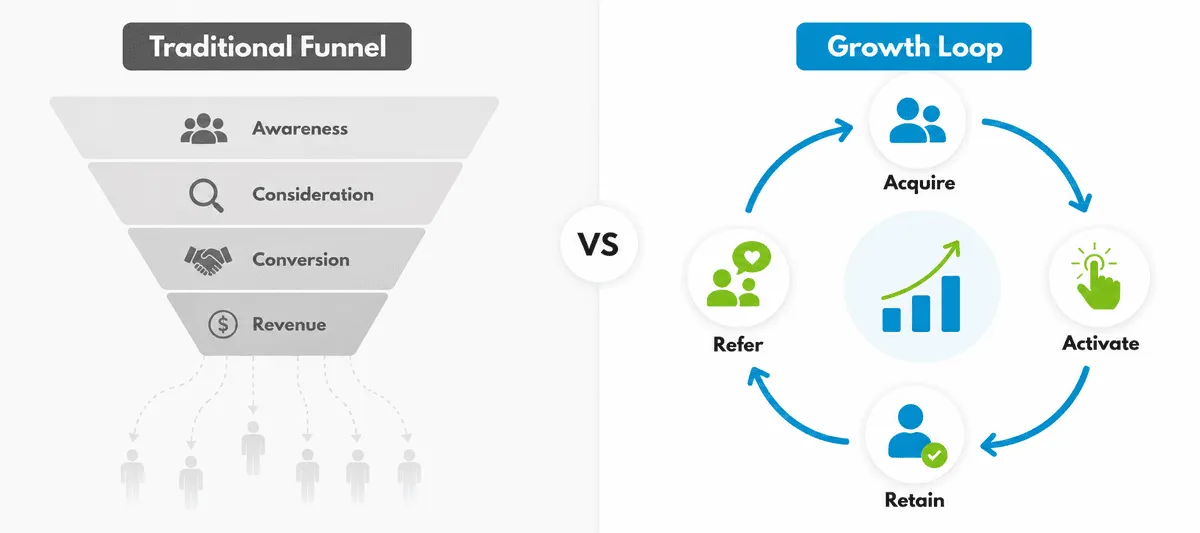
Modern strategies no longer rely on funnels where customers drop off. Instead, they use growth loops, where one user’s action helps bring in another. This creates a system that depends less on paid ads.
- Nurturing Existing Customers
Due to strict privacy regulations, the cost of acquiring new customers has increased. Growth marketing now prioritizes retention-led strategies.
Compliance with frameworks like GDPR (General Data Protection Regulation) in Europe, CCPA/CPRA (California Consumer Privacy Act) in the US, and the global deprecation of third-party cookies (files used to track users across the web) has restricted the ability to target new users with precision.
Initiatives like the Google Privacy Sandbox reinforce this shift. Marketers must now operate within privacy-first environments. As a result, companies focus on maximizing the value of existing customers who provide first-party data (information collected directly from users through direct channels) through direct interactions.
- Building Structures for Customer Data
Growth teams store and structure this data using vector databases. These systems store information as numerical representations called embeddings, allowing AI to search by meaning rather than exact matches. This leads to AI agents able to retrieve and act on behavioral insights in real time.
Tools like Pinecone and Weaviate are commonly used to capture embeddings and scale their storage derived from customer actions.
This infrastructure supports Retrieval-Augmented Generation (RAG), an AI framework where models retrieve relevant external data before generating responses. RAGs help improve accuracy and personalization where AI agents can access relevant user data instantly and personalize engagement.
Growth Marketing vs. Traditional Marketing
The primary shift in 2026 is the move from brand awareness to performance-driven growth. Traditional methods are now limited by the deprecation of third-party cookies. Growth marketing solves this by using server-side tracking (collecting user data through a company-controlled server) and first-party data to analyze behavior while maintaining privacy.
5 Key Differences for Professionals
How to Track Growth Marketing Metrics
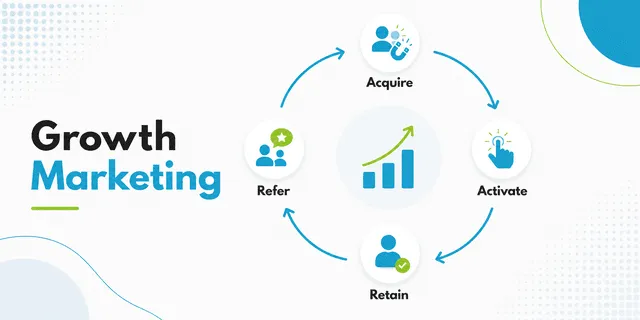
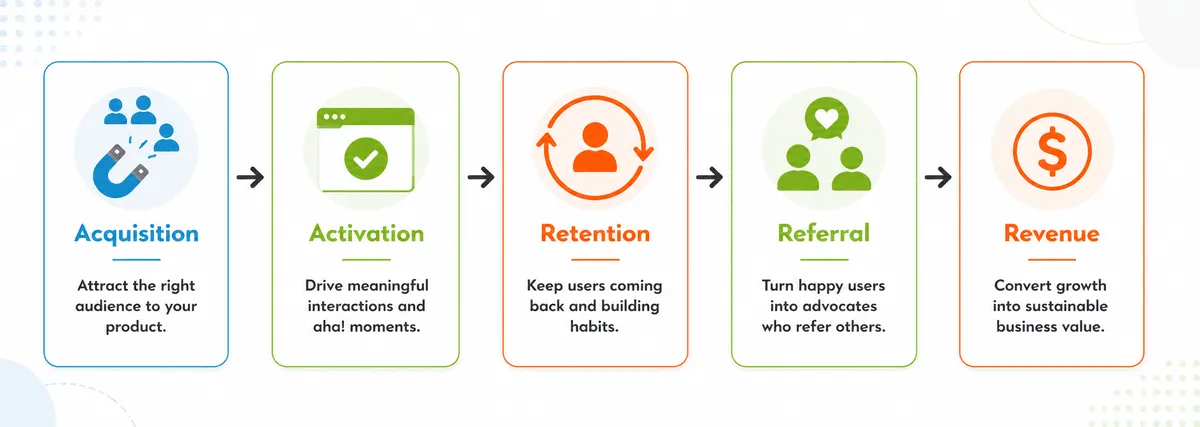
The AARRR framework, also known as Pirate Metrics, provides the roadmap for tracking business health. Each stage represents a specific KPI (Key Performance Indicator) that growth teams must optimize:
- Acquisition: Driving high-intent traffic from users ready to engage.
- Activation: The moment a user experiences the core value of the product.
- Retention: Minimizing churn rate, which is the percentage of customers who stop using the service.
- Referral: Quantifying growth via the K-Factor, a formula that measures how many new users each existing user recruits.
- Revenue: Calculating the payback period to determine how quickly a business recovers its CAC.
Data Analysis in Growth Marketing
By 2026, data science is used for more than simple testing. Growth teams employ sophisticated modeling to understand user behavior and product-market fit.
- Zero-Party Data: Information that customers intentionally share, such as preferences or purchase intentions.
- Predictive Modeling: Using AI to forecast which customers have the highest probability of repeat purchases.
- Cohort Analysis: Grouping users by their start date to determine if product updates improve long-term retention.
How Growth Marketing Automation Improves Performance
Marketing automation has evolved from simple triggers into autonomous systems run by AI agents, where a majority of operational tasks are automated for growth teams to focus on high-level strategy. This shift from manual execution to automated orchestration is the primary driver of performance in 2026.
- Autonomous Campaign Orchestration: AI agents manage budgets and optimize creative variants in real time, powered by advanced models such as GPT-5 and Gemini 3 Flash. These engines enable real-time reasoning and decision-making at scale. For example, VELUX integrated AI to generate custom product visualizations instantly. This reduced production time from three weeks to five minutes, allowing sales teams to provide immediate, personalized value.
- Answer Engine Optimization (AEO): Systems format content using schema markups so AI models can cite the brand in chat interfaces. Under GreenBananaSEO, a B2B agency using AEO reports up to 300% increase in qualified leads by capturing users who conduct research via AI tools rather than search engines.
- Dynamic Lead Scoring: Agents monitor intent ledgers to prioritize prospects. Noble utilized enrichment APIs to build an automated outreach engine that identified which domains LLMs were citing. This targeted approach achieved a 10% conversion rate from cold contacts by ensuring outreach was both timely and highly relevant.
Final Thoughts
Growth marketing in 2026 requires a fundamental shift from broad, creative-led outreach to technical, data-centric precision. By prioritizing unit economics and leveraging AI for autonomous orchestration, businesses can achieve sustainable scale despite a more regulated digital landscape.
Next Steps:
- Move beyond third-party cookies by implementing systems to capture first-party and zero-party data directly from your users.
- Map your customer journey to identify where one user's action can naturally trigger the acquisition of another, reducing reliance on paid media.
- Pinpoint the exact interaction where users experience your product’s core value and run weekly experiments to shorten the time it takes to reach that point.
- Explore AI agents to handle operational tasks like real-time budget management or Answer Engine Optimization to capture leads from AI chat interfaces.
Frequently Asked Questions (FAQs)
What is the difference between traditional and growth marketing?
Traditional marketing often focuses on top-of-funnel brand awareness and months of planning for static campaigns. Growth marketing is experimentation-first, using rapid weekly iterations to optimize the entire customer lifecycle for bottom-line revenue.
How do privacy laws affect my marketing strategy?
Regulations like GDPR and the loss of third-party cookies make it harder to track and target new users. Consequently, marketers are switching to first-party and zero-party data (information users share willingly) to maintain privacy while analyzing behavior.
What is a Growth Loop?
Unlike a traditional funnel that loses people at the bottom, a growth loop is a self-sustaining system. It’s designed so that the actions of one user (like a referral) provide the input to acquire the next user.
Related Content
Read These Next
Benefits of Marketing Automation: 10 Reasons Why It’s Your Best Investment in 2026